





Ginnunga Gap Polytechnic is undoubtedly the best faux institution of higher education that never existed. You can earn a Wonderment Diploma from Ginnunga Gap’s Mechatronics and Robotics program (WD-40)! The program will start in January 2018 and run for two years until December 2019. It is available at the Unit One work space in Ginnunga Gap, otherwise known as Vangshylla.
There will be two participation levels, superficial and exhaustive.
Superficial is designed for people who simply want an overview of the field of mechatronics and robotics.
Exhaustive is at the other extreme, with time devoted to solving problems, theoretical as well as practical.
Even if a Wonderment Diploma isn’t worth the paper it’s printed on, the education on offer will, at the exhaustive level, be as close as possible to a clone of the mechatronics and robotics program offered at the British Columbia Institute of Technology. Given the opportunity to study at BCIT in Burnaby, you will undoubtedly receive a better education there than you will get at Ginnunga Gap. However, if you are unfortunate enough to be stuck in Greater Ginnunga Gap, and lack the funds to pay international tuition fees, the education offered by Ginnunga Gap Polytechnic may be good enough.
The following description of the Mechatronics and Robotics program is a ruthless plagiarism of BCIT’s promotional materials.
WD-40 will provide you with insights into a world where mechanical products contain computers and electronics for monitoring or control. This integration of mechanical and electronic components (mechatronics) makes it possible to design intelligent, reliable, versatile electromechanical systems such as industrial robots, medical devices, aircraft simulators, automated assembly lines, building control systems, and autonomous vehicles.

THE PROGRAM
The Mechatronics and Robotics program at Marmot University focuses on the automation of electromechanical devices and the application of robotic manipulators. You’ll receive hands-on, interdisciplinary training in:
The Mechatronics and Robotics program can open many doors. It will provide an advanced education in electromechanical systems and give the benefit of small
class sizes so you can master complex topics by taking advantage of the one-on-one time with instructors. After two years you will earn a wonderment diploma and have the skills to make a good living.
JOB OPPORTUNITIES
Mechatronics and robotics gives many interesting job possibilities. Because it is multidisciplinary, it also prepares for leadership roles in the design and creation of innovative mechatronics products for a variety of applications, including designing
and building automated equipment for the movie industry, medical devices,
production equipment, or submarines.
Here is what we will be working on:
| Level 1 (15 weeks) | Credits | ||
|---|---|---|---|
| COMM 11 | Technical Writing 1 for Robotics | 3.0 | |
| ELEX 11 | DC Circuit Analysis for Robotics | 6.0 | |
| ELEX 12 | Digital Techniques 1 for Robotics | 6.0 | |
| MATH 11 | Technical Math for Robotics | 6.0 | |
| MECH 11 | Computer Aided Design | 4.0 | |
| PHYS 11 | Physics for Robotics 1 | 5.0 | |
| Level 2 (20 weeks) | Credits | ||
| ELEX 21 | AC Circuits for Robotics | 6.5 | |
| ELEX 22 | Digital and Electronic Circuits | 8.0 | |
| MATH 21 | Calculus for Robotics | 8.0 | |
| MECH 12 | Manufacturing Processes | 5.5 | |
| PHYS 21 | Applied Physics 2 for Robotics | 6.5 | |
| ROBT 11 | C Programming | 6.5 | |
| Level 3 (15 weeks) | Credits | ||
| ELEX 31 | Electronics Circuits 2 (Robotics) | 6.0 | |
| MATH 31 | Transform Calculus (Robotics) | 4.0 | |
| MECH 31 | Fluid Power 1 | 4.0 | |
| ROBT 31 | Robot Applications | 6.0 | |
| ROBT 32 | Automation Equipment | 5.0 | |
| ROBT 33 | Controller Systems | 6.0 | |
| Level 4 (20 weeks) | Credits | ||
| COMM 21 | Technical Writing 2 for Robotics | 4.0 | |
| ELEX 41 | Feedback Systems | 8.0 | |
| MECH 00 | Ethics for Technologists | 0.0 | |
| MECH 41 | Fluid Power 2 | 4.0 | |
| OPMT 11 | Industrial Engineering | 5.5 | |
| ROBT 41 | Sensor Interfacing | 8.0 | |
| ROBT 42 | PLC Applications | 4.0 | |
| ROBT 43 | Mechatronics Project | 6.5 | |
| Total Credits: | 142.0 | ||
While it is a long time before students will be working on their Mechatronics Project, Unit One is looking for opportunities to make devices capable of monitoring the marine environment in Skarnsund and Børgin, in cooperation with the local chapter of Friends of the Earth.
While Ginnunga Gap Polytechnic has fake application forms, and mock procedures to select students, the best way to come on board is to speak directly to one of the phony personas at Unit One.
PS. Your bogus Wonderment Diploma will be printed in A3 format. Its massive size should intimidate friend and foe alike.
Guest author: Proton Bletchley
Golf courses can be described as green deserts. It is a half-truth. A lot of grass can be grown on them, they are not noted for their ecological diversity, but they aren’t deserts. For the past few days, I have been a regular visitor to a food desert, Cain’s, Your Independent Grocer, in Thompson Country. Again, that sentence contains a lot of half-truths.

Let’s begin by clearing away some half-truths. Thompson country is Kamloops. Jason Cain is a franchise owner/operator. Your Independent Grocer, is a supermarket chain owned by National Grocers, which is part of Loblaw Companies Limited. So much for independence. See: https://en.wikipedia.org/wiki/Your_Independent_Grocer
The store isn’t really a food desert. One major challenge of visiting this store, despite its enormous size, is finding something edible to eat. My estimate is that about 90% of their food-category products are processed. This means that they contain larger quantities of sugar, salt and additives, than I appreciate. The other 10% of the store contains fairly healthy food. My travelling companion, Daffy Marmot, was impressed with the fresh produce section. The Blue Menu Bleu assortment seemed to meet our culinary tastes.

The peanut butter contained 100% peanuts, which means no salt, no sugar, no additives. We enjoyed the crunchy variety, and didn’t mind the separation of the oil, which had to be stirred in. It was all part of the healthy food experience.

One major problem with today’s food stores is the obesity caused by easy access to inappropriate foods. People succumb to temptation. Physically separate people from food, and many of the problems associated with instant gratification will disappear. This too is probably only a half-truth.
Personally, I don’t want to order food. My refrigerator and storage cupboards should be perfectly capably of tracking inventory, and making purchases from an online supplier. My role should only be to make a few supplementary purchases, preferably only within one hour after eating a meal. Don’t worry. Such dictatorial measures will not happen as long as large corporations are profiting from obesity.
One of the objections made to online grocery purchases is an inability to feel produce, things like apples. Yuck, the last thing I want to purchase is an apple that has been touched by 100 different people.
One solution is the use of collaborative robots (cobots) in the food chain. A cobot is “an apparatus and method for direct physical interaction between a person and a general purpose manipulator controlled by a computer.” http://www.foodqualityandsafety.com/article/robots-help-boost-food-chain-productivity/?singlepage=1&theme=print-friendly
Market leader is the Danish company, Universal Robots, with about a 60% market penetration. Collaborative robot arms belong to an emerging new class of industrial robotics that can operate outside of safety enclosures alongside employees.

Soft Robotics is also making an impression in the market, because their tools can delicately pick and pack food products.

London based, but with its Engineering department in Tallinn, Estonia, Starship Technologies has launched a nine-month pilot program to test out the Starship’s robots on public sidewalks in Redwood City, California. It partnered with food-delivery service Doordash to have its robots transport meals from restaurants in Redwood City’s downtown area. Starship’s robots move just slightly faster than walking speed, about 6 kmh, and they have a range of 3 km. During this testing phase, Starship uses living employees to babysit robots on deliveries. Their ultimate goal is to drive down the costs to less than $2 per delivery. If food deliveries are successful, the company hopes to quickly expand its business to handle grocery trips and delivering parcels.

The Swiss company, TeleRetail, is testing delivery bots in Mountain View. The robots are designed to offer a for-hire service that can be adapted to various tasks. Their business model is based on the Zipcar: anybody can use the robots to run whatever errands they want. They offer a complete logistics platform that enables them to integrate any mode of transportation.
Myrmex is launching an unmanned grocery delivery system using mobile robotic units. It is capable of delivering an online order just seconds after customer arrival at a pick-up point. The system is called CPS for Curbside Pickup System. Each online order is put into a plastic box which is then placed on a wire frame (pod) with a capacity of 20 boxes. According to Myrimex, more than 50 percent of the online grocery shoppers (young families with children, working people with irregular schedule) are reluctant to choose home delivery because of the challenges in meeting a timeslot. Click & collect gives users advantages in terms of personal time management, and lower costs. http://www.myrmex-inc.com/
Some of the proposed delivery solutions may also turn out to be half truths. Daffy Marmot, for example, feels that many (male) technologists have underestimated the social value of shopping.
About the Author: Proton Bletchley is Chief Scientist at Unit One. He is also heading a program leading to a Wonderment Diploma in Mechatronics & Robotics, from Ginnunga Gap Polytechnic. This is not just a half-truth, it is a non-truth.


Welcome to the Unit One Work Space, Ethan & Ethel. Here, everyone is required to wear appropriate clothing and safety equipment.
A lot of information about personal protective clothing and equipment is available from WorkSafeBC: https://www.worksafebc.com/en/law-policy/occupational-health-safety/searchable-ohs-regulation/ohs-regulation/part-08-personal-protective-clothing-and-equipment
Unit One uses the regulations here as guidelines for setting its own policy. Sometimes the rules are even stricter than those the government requires.
Identity Cards and Patches
At Unit One, everyone is issued an identity card. This contains a lot of information that could be needed in acute situations. For example, it lists name, birth date, blood type (if known), current medications, chronic medical conditions, allergies, personal contact information, and contact information in case of an emergency.
While this information is also stored in an encrypted format in the Unit One database, it is important to have this information physically available. Computers don’t always work.
| Unit One | Billi Sodd |
| Birthdate: | 1950-01-01 |
| Medications: | Insulin |
| Allergies: | none |
| Blood Type: | O |
| Emergency Contact: | Ivan Sodd 604-527-4660 |
The ID card also lists courses you have taken such as first aid and hot work, as well as the machines your are qualified to use.
Qualification |
Status |
Expiry Date |
| First Aid | Basic | 2019-01-01 |
| Hot Work | Basic | 2020-01-01 |
| Table Saw | Supervisor | 2020-01-01 |
| Mitre Saw | Supervisor | 2020-01-01 |
| Band Saw | Supervisor | 2020-01-01 |
| Planer | Basic | 2025-01-01 |
| Router | Basic | 2025-01-01 |
| CNC | Lathe; Mill | 2025-01-01 |
| Electronics | DC; AC | 2050-01-01 |
| 3D printer | Basic | 2050-01-01 |
| Laser cutter | None | – |
A Unit One ID patch is available to sew onto work jackets. This includes the Unit One logo, and your name. Its colour indicates your work status: orange – novice, must work under supervision; yellow – qualified, allowed to work without supervision; white – supervisor, allowed to train and supervise other people; blue – member of the board of directors.
Clothing
Personal clothing must be of a type and in a condition which will not expose the worker to any unnecessary or avoidable hazards. First of all, this means that no dresses or skirts are allowed, girls. This is because trousers are safer to work in. Because there is a danger of contact with moving parts of machinery or with electrically energized equipment, clothing must fit closely about the body,

Neckwear, bracelets, wristwatches, rings or similar articles may not be worn, except for medical alert bracelets. Similarly cranial (that means head) and facial hair must be confined, or worn at a length which will prevent it from being snagged or caught in the work process.
Everyone at Unit One must have suitable gloves to protect hands from abrasion, chemical or other injury.
Flame resistant clothing must be worn when performing hot work, including welding.
Headgear
Unit One provides safety headgear in situations where there is a danger of head injury. Our headgear is colour coded (see above).

Eyewear & face protection
Properly fitting safety eyewear must be worn if one is handling or exposed to materials which are likely to injure or irritate the eyes. In some cases these must be fitted with sideshields.

If there is a risk of face injury, suitable face protection must be worn.
Footwear
Footwear must be of a design, construction, and material appropriate to the protection required. The following factors must be considered: slipping; tripping; uneven terrain; abrasion; ankle protection and foot support; potential for musculoskeletal injury; crushing potential; temperature extremes; corrosive substances; puncture hazards; electrical shock; any other recognizable hazard.
Hearing protection
While we have a supply of ear plugs at Unit One, we encourage people to use ear muffs. These offer less noise-reduction variability among users, are designed so that one size fits most head sizes, are not easily misplaced or lost, and may be worn with minor ear infections. However, they are less portable and heavier than ear plugs, may be less convenient for use with other personal protective equipment, may be less comfortable with hot work, and may interfere with the wearing of safety glasses because wearing glasses breaks the seal between the ear muff and the skin, resulting in decreased hearing protection.

Respirators and face masks
We typically use non-powered, air purifying half facepieces with sorbent cartridges when working with organic solvents. If dust is the issue, we use face masks.

First Aid kit
At the entrance to Unit One there is a first aid kit that contains most items that should be used to treat minor injuries. This kit is never locked, and is accessible to everyone.

Fire extinguishers
Unit One is equipped with two fire extinguishers, suitable for all types of fires. These are located at opposite ends of the workshop.

Next time, we will be focusing on air quality management.






It doesn’t happen often, but a new family has moved into Ginnunga Gap. I haven’t seen much of Maw and Paw Maker, but their children, Ethan and Ethel, have already started hanging around the Unit One workshop.
The twins are 15 years old, and just starting out to make things. At Unit One we’re going to be writing some posts that will help them figure out what to do in a workshop. We want to make sure they learn how to “Do It Ourselves” safely.
Personal safety equipment
Air quality management
Electrical power
Computer control
Mechanical components
3D-scanning
3D-printing
Computer Aided Design
CNC machining
The Workshop
Woodworking
Metalworking
Electronics
A post from the office of the Unit One Chief Scientist, Proton Bletchley.
Let’s begin by looking at the dictionary.
cogitation n. c.1200, “thought, idea, notion,” from Old French cogitacion “thought, consideration, reflection,” from Latin cogitationem (nominative cogitatio), noun of action from past participle stem of cogitare “to think, reflect, consider, turn over in the mind,” apparently from co-agitare, from com- “together” (see co-) + agitare, here in a sense of “to turn over in the mind,” literally “to put in constant motion, drive, impel,” frequentative of agere “to move, drive” (see agitation).” Online Etymology Dictionary, © 2010 Douglas Harper
| Mental activity | Sport | Other hobby | |
| Charles Justice | Philosophy | Kayaking | Drumming |
| Unit One | Cogitation | Surfing; Sparking | Mechatronics; Robotics |
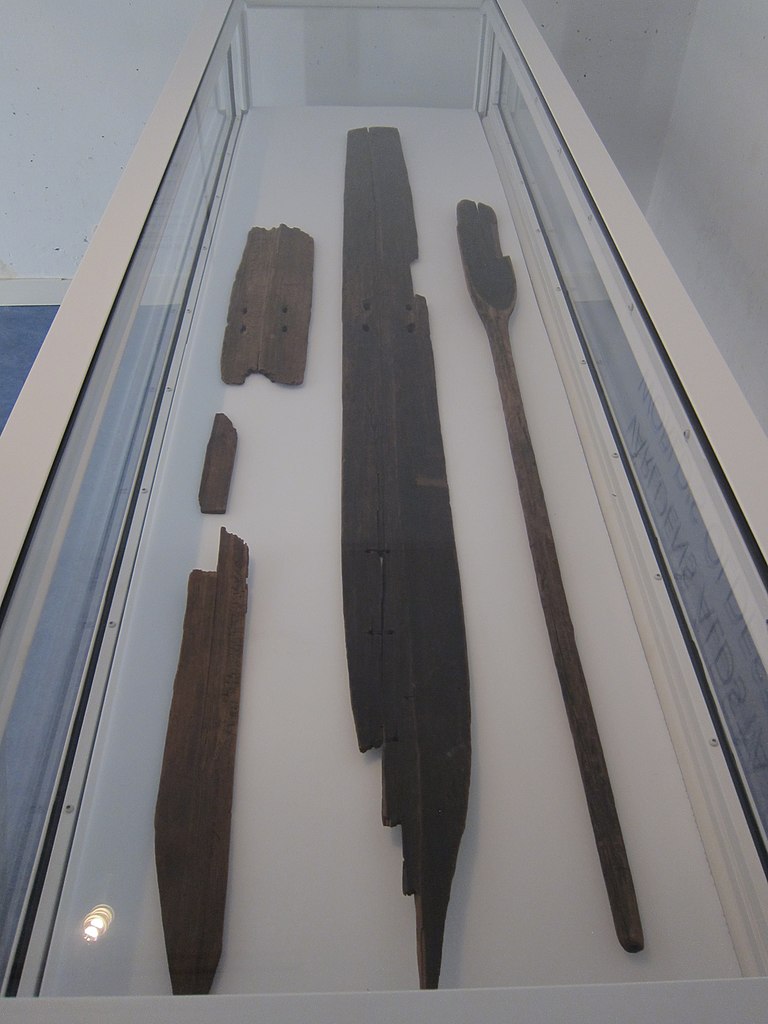
The first primitive Scandinavian ski was found in a peat bog in Hoting in Jämtland County in Sweden which dates back to 4500 BP (Before Present) or 2500 BCE (Before Christian or Common Era).
The oldest set of skis is probably the Kalvträsk skis, found in 1924, at Kalvträsk near Skellefteå, Sweden. Two skis measuring 2040 mm by 155 mm and a shovel shaped ski pole was 1560 mm long. Carbon dating indicates that the equipment is 5200 years old. The skis were made from pine that had grown on a slope, causing the wood to become denser than ordinary. Each ski had four holes for the bindings, which corresponds with ancient skis found in Siberia. The ski pole is similar to ski poles used in historic times by the Sami people in northern Scandinavia. The equipment is on exhibition at the Västerbottens Museum in Umeå.
While skis are useful for exercise by healthy adults, they are not particularly useful for routine winter transport by small children, or adults who have passed middle age. It is here that the kicksled, or spark, offers a more suitable vehicle.
A Kicksled museum is located in Piteå, Sweden, where the vehicle was first developed in the 1860s and 1870s. The museum claims that “The spark is a fantastic transport tool that is in every way in time. It is energy-efficient, environmentally friendly and in many cases shapely fashionable.” https://www.pitea.se/Besokare/Se–gora/Produkt/?lang=sv&TLp=462944

The first kicksleds had stiff wooden runners and were heavy. In 1909 Erik Timander and Anders Bertas in Orsa, Dalarna County, Sweden designed and produced the first modern kicksled, the Orsasparken, with its two patented spring-steel runners.

The traditional spark is fitted with a chair, which is useful for carrying a passenger, while the “driver” stands behind on one of the runners, and kicks the vehicle forward.
In 1994, Hannu Vierikko founded Kickbike Worldwide that developed modern scooters and kicksleds. He claims that these represent Finnish design at its best, by combining unique design with functionality.
“The Kickspark is a new design of a kicksled. Traditional style kicksleds have been in daily use in Scandinavian winter since the beginning of 20th century but for some reason the design has remained the same while other products have been developed a lot. The new, innovative design takes the old winter product to a new level. The Kickspark suits as well for all round use as for sport and fitness. The frame is light and stiff offering excellent control also at high speeds – or for tall riders.
“The handlebar comes with comfortable and warm hd foam grips. You can fold the frame by loosening two bolts or completely disassemble the sled using 6 bolts. This way transportation and storage is quite easy.
“Kicksled can be used anywhere, where you would use skis or ice skates and quite a bit beyond too. For the best ride, choose runners for the surface you plan to ride on. The Kickspark comes standard with steel runners, that can be used in most conditions: ice, snowy and icy roads, paths and trails with a relatively hard snow surface. Those work fine if one can walk on the snowy surface without sinking. The standard runners are made of 5 mm wide and 28 mm tall zinc coated spring steel.
“Snow Runners are plastic skis that support the kicksledder even on snowmobile or cross-country ski trails. Snow runners come in two widths: 36mm and 56mm for softer tracks. Those glide better than steel runners in snowy or cold (-10C/15F or colder) conditions.
“Ice Runners are designed exclusively for kicksledding on ice, similar conditions as skate touring but work better than skates on rough or soft ice surface. Ice Runners glide amazingly well and quietly, yet the grip and control are far better than in the Standard Runners.
“Kicking on snow-free ice with the Ice Runners is a whole new winter sports and outdoors experience. Racers reach speeds of 25-40km/h depending on the distance (100km record being 3:38:50). Long touring on (sunny?) spring ice is something Kickspark riders keep talking about when the ice is gone.
“Even the fastest sled needs a grip under the kicking feet to propel it forward. On snowy surfaces in temperatures well below freezing normal winter boots work fine. On an icy road or lake studded winter boots/ running shoes or crampoons work better. Crampoons are studded (steel studs normally) kicking soles that can be attached to virtually every shoe. The best alternative are spike shoes originally designed for (Finnish) baseball or orienteering equipped with 9-12 mm spikes, some use even golf shoes. Stability/stiffness of the shoe is important.” http://www.kickbike.com/en/kickspark.html
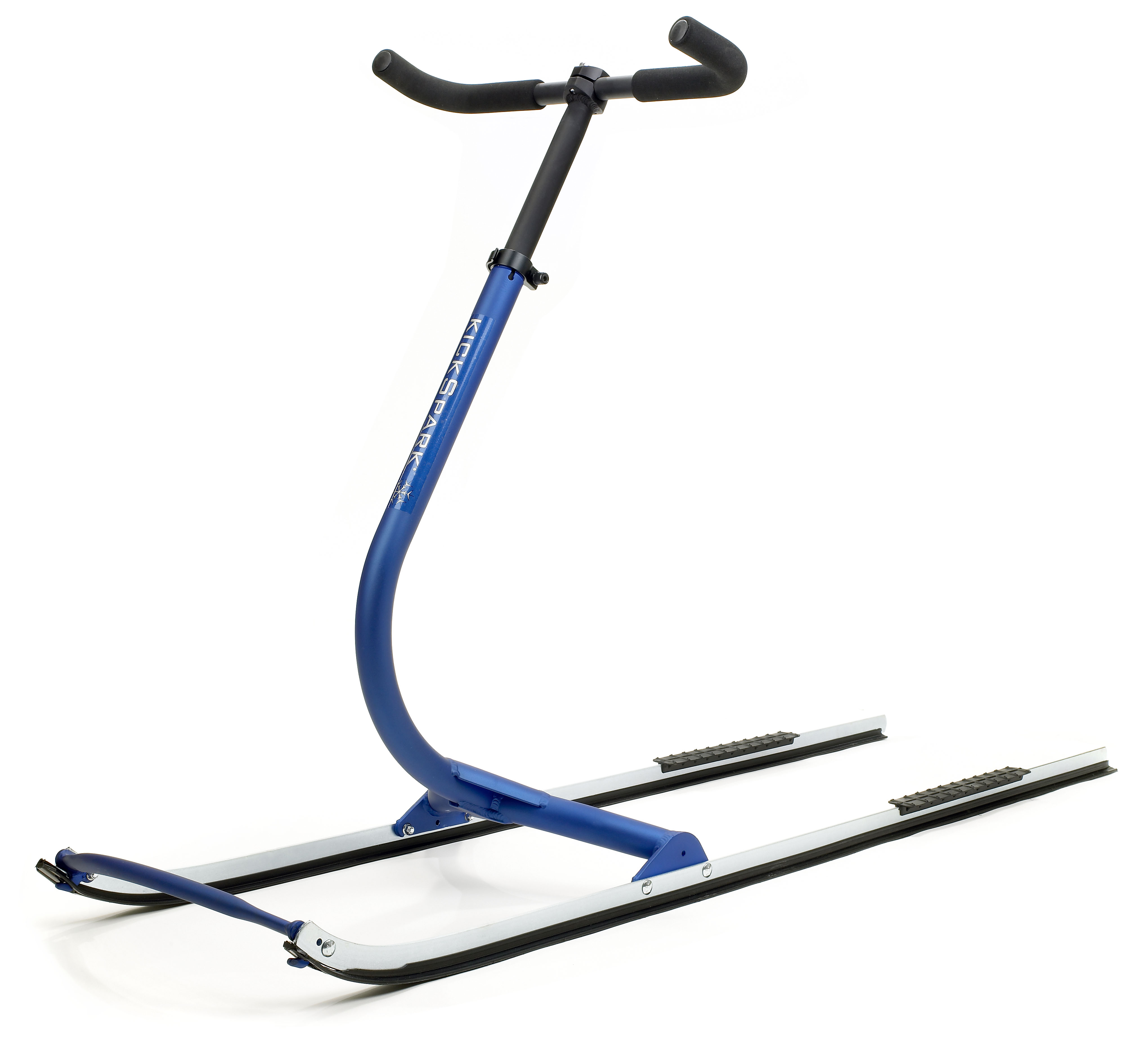
So much for the commercial announcement. With a sales price of about NOK 3 000 (CAD 500) including freight, I won’t be buying a Kickspark Max anytime soon. However, that much money can buy a lot of material to use in the Unit One workshop.
Anyone with a derelict spark they want to get rid of, is invited to take contact.
Update: 2022-05-04
Yesterday, Tuesday 2022-05-03, we acquired our first “Spark”. It was purchased from Reodor, in Straumen, Inderøy for NOK 50. Yes, it was an impulse purchase.
