Sustainable Aviation

Virgin Atlantic Flight100, a Boeing 787 Dreamliner, equipped with Rolls Royce Trent 1000 engines, using SAF = sustainable aviation fuel on a transatlantic crossing from London Heathrow to New York JFK. Photo: Rolls Royce.

With family equally divided between North America and Europe, I am doomed to an immoral life of using commercial airplanes to interact with them in person, between continents. Of course, additional immorality comes from flying for pleasure within Europe.

This weblog post reflects on the content of The six problems aviation must fix to hit net zero, an article by Joycelyn Timperley appearing in The Observer 2021-09-05. In it, she commented: Aviation is a complicated sector to decarbonise. It has some prickly ingredients: difficult technological solutions, hidden extra climate effects, an association with personal freedoms and a disproportionately wealthy and powerful customer base.

Almost four and a half years later, this weblog post will use her subject headings, but look what has happened in the intervening years, to address these issues. The first comment is that journalist Timperley is attempting to quote people to support her arguments. I have eliminated these quotations because they are general and unoriginal.

1. The fuel problem

Flying requires a lot of energy, and fuels with high energy density. I disagree with the premise that fossil fuels are the only available option for airplanes. One answer is to insist on the use of synthetic fuels, commonly called sustainable aviation fuels (SAF). This may require engine manufacturers such as Rolls Royce, to make/ modify engines specifically designed for the fuel. Even if fossil fuels continue to be used, they should be priced to ensure that the damage they contribute to the planet can be fully mitigated. There is no reason why the equivalent quantity of CO2 and other waste gasses cannot be scrubbed from the atmosphere, to make a carbon neutral product. SAFs accounted for less than 0.1% of aviation fuel consumption in 2018, in 2023 it was still less than 0.1%.

The fuel efficiency of aircraft improves over time. There is no magic involved, just the out-phasing of older aircraft with more efficient new aircraft. For example, switching from an older Boeing 747s to a more efficient Boeing 787s or Airbus A350s, can reduce carbon emissions by up to 30%. However, this improvement will not reduce total emissions. If aviation is becoming about 3% more efficient each year, passenger demand is increasing by about 5% a year.

In 2021, the European Commission presented the Fit for 55 package: a series of proposals to make the EU’s climate, energy, land use, transport and taxation policies fit for reducing net greenhouse gas emissions by at least 55 % by 2030, compared with 1990 levels. The European Commission proposes obligations on fuel suppliers to provide a minimum share of SAF that increases over time. The main goal is to increase use of SAF, resulting in a reduction of overall aviation emissions. A major problem with these commission proposals, is that the numbers are not concrete, with adherence voluntary. This will result in most airlines ignoring the proposals to avoid increased costs.

SAF is technologically ready for use, but a European Union framework to increase SAF is not. Other governments, such as the UK, want at least 10% SAF in place by 2030. There seems to be no plan to increase that to anything above that level. There are currently less than 6 years to ramp up from 0.1 to 10%. Regulations in effect restrict SAFs to 50% of fuel used. The first SAF-powered transatlantic flight, Flight100, involved a Virgin Atlantic Boeing 787, equipped with Rolls-Royce Trent 1000 engines. It took place 2023-11-28 between London Heathrow and New York JFK. This demonstrated that such journeys are possible.

The SAF used on Flight100 was: 88% HEFA (Hydroprocessed Esters and Fatty Acids) supplied by AirBP and 12% SAK (Synthetic Aromatic Kerosene) supplied by Virent. HEFA is made from waste fats, SAK is made from plant sugars, with the remainder of plant proteins, oil and fibres continuing into the food chain. SAK is needed in 100% SAF blends to give the fuel the required aromatics for engine function.

The real reason SAF is not used has to do with its price. Airlines as well as their customers prioritize lower costs. This means that regulators, government or international, will have to impose relevant regulations to ensure useage of SAF.

Despite many believers the most promising sustainable fuels will not be made from waste biofuels, like used cooking oils. They may be cheap and offer good life-cycle emissions, but its supply is limited. Even if all of these fuels were used exclusively for aviation, they would only provide about 2% of jet fuel use in the EU and US. In other words, it is not a solution.

Biofuels can also be made from crops such as palm, soya and corn. However, environmental groups have been arguing against these because they can compete with food production and drive deforestation – proposed EU legislation that aims to ramp up SAFs specifically excludes their use. Advanced biofuels from cellulosic plants and agricultural and forestry waste show more promise.

A final type of fuel that could be used in current aircraft is “electrofuel”, made using clean electricity and hydrogen. In theory, these could have an “almost unlimited supply”, says Rutherford, but they are currently very expensive to make.

There are also completely different kinds of aircraft on the horizon. While the size and weight of current battery technology mean electric propulsion is still a long way off for larger aircraft, electric planes are appearing on shorter routes. Yet, one of the key areas where electric aircraft need to make an impact, is with flight schools. For example, the Slovenian Pipistrel Velis Electro aircraft are in use for pilot training at Green Flight Academy in Skellefteå, Sweden. Starting in 2019, several smaller electric aircraft have appeared in this weblog: A retrofitted Beaver at YVR airport in Richmond, British Columbia;

Some companies are working on new kinds of aeroplanes designed to run on hydrogen gas, which could also be produced using clean electricity. Last year, Airbus revealed its concept for a hydrogen aircraft that it said could enter service by 2035, although it has also admitted such planes won’t be widely used until after 2050.

Chances of being solved? Clean fuels are likely to be used more and more but will make up only a few percent of fuel by 2030 and are unlikely to make a significant impact until after 2050.

2. The non-CO2 problem

Aviation accounts for about 2.5% of global CO2 emissions, but its warming impact is far larger because of other gases and particulates it emits at high altitudes. These are often called non-CO2 impacts, these include nitrogen oxides and contrail clouds = line-shaped vapor trail clouds produced by aircraft engine exhaust or changes in air pressure, typically at aircraft cruising altitudes several km above the Earth’s surface. They are composed primarily of water, in the form of ice crystals. These are rarely specified in aviation climate goals, but they could triple the climate impacts of aviation compared with CO2 alone.

What’s problematic, but also promising, about these effects is that they vary substantially depending on the surrounding climatic conditions. For example, one study found that just 2% of flights contribute to 80% of contrail warming effects. Night-time flights are particularly bad, because contrails produce their warming impact mainly at night.

It’s important to note that low-carbon fuels can still produce non-CO2 impacts, although these are expected to be lower than for kerosene for most fuels.

Chances of being solved? Unlikely in the near term given low prominence. However, the EU is beginning to pay more attention to this issue.

3. The frequent flyer problem

Some argue technological solutions will be too slow to reduce emissions in the aviation sector, and measures to reduce the amount people fly are needed to limit the damage to the climate.

But flying is not an evenly spread activity. In the UK about 15% of the population take 70% of all flights, and around half of people don’t fly at all in any given year. “That’s a pattern replicated in many other counties,” says Cait Hewitt, policy director at the Aviation Environment Federation (AEF).

The inequality in flying is even more stark at a global level. One study estimated that just 1% of the world’s population emits 50% of CO2 from commercial aviation, while just 2-4% of people fly internationally in a given year.

Some campaigners therefore support a “frequent flyer levy” as a fairer way to limit aviation emissions. The UK campaign A Free Ride argues everyone should have one annual flight free from the levy, then pay a rising charge for every extra flight taken that year. The UK’s first climate assembly also backed the idea of a frequent flyer levy.

The problem with such a levy is that many people in the frequent flyer category are likely to have the wealth to pay a moderate levy, or to have it paid by their employers, says Wood.

Manuel Grebenjak, a campaigner at the Stay Grounded network, says measures to limit flights overall, such as banning flights on certain routes, could help to stem rising emissions in a fairer way. “If a flight is banned from a certain city to another one, no one can fly, so it’s very just,” he says.

France has already moved to ban domestic flights on routes that can be travelled by train within two-and-a-half hours. Even just providing an alternative to flying can be effective: new high-speed rail lines have reduced aviation transport on the same routes by up to 80%, according to the International Energy Agency (IEA).

Chances of being solved? Governments,including the UK, tend to shy away from demand management approaches to limiting aviation emissions, but France and Austria are making good first steps.

4. The policy problem

All this feeds into a wider need for strong policy to tackle aviation emissions, which has largely been lacking so far. “International aviation sits outside the Paris climate agreement, because that agreement is about a country’s domestic emissions,” says Harvey. “So there was a real push to have a scheme for international aviation.”

After years of inaction, in 2016 countries at the UN aviation agency, ICAO, agreed on the Carbon Offsetting and Reduction Scheme for International Aviation (Corsia), a global deal to “offset” the growth in aviation emissions above the average levels in 2019 and 2020. However, when flights plummeted during the pandemic, countries changed the baseline of this scheme, which means there are currently no obligations on airlines. Egeland says Corsia’s effectiveness will “ultimately depend on the quality of carbon offsets that ICAO will accept”.

ICAO is also in discussions over a long-term climate goal for aviation for 2050, but it is not clear when this will be agreed or what the target will be.

Meanwhile, policies are being increasingly discussed at the national and regional level. In particular, the EU’s proposed “Fit for 55” climate legislation includes plans to mandate targets for SAFs and to end aviation’s fuel tax exemption. “Aviation fuel is exempt from any taxes almost everywhere,” says Grebenjak. “The EU wants to end the basically free rider status of aviation, and implement a kerosene tax that’s at the same level as other fuels.”

Chances of being solved? ICAO has been notoriously slow to act on aviation emissions, and many environmental groups criticise CORSIA for being far too weak, but recent policy moves at the EU level represent a significant step change.

5. The new middle class problem

Action at the EU level is encouraging, and the UK government even has a consultation out on its strategy for net zero aviation. However, the biggest growth in flying in the coming decades is expected outside Europe and the US, especially among the growing middle classes of developing countries.

Asia and the Pacific, Africa and the Middle East are the regions expected to see the most growth in the next 20 years, and last year China overtook the US as the world’s largest air passenger market. “The rise of a travelling middle-class in China and India has seen passenger demand grow at around 10% per annum,” says Hewitt.

Rutherford adds that frequent flyers look similar wherever in the world they are, namely upper-middle-class professionals. A global frequent flyer levy could therefore be one way to curb the growth, he says.

Chinese airlines will also increasingly have to meet local rules designed for climate mitigation if they want access to international airports, says Hewitt. But the vast majority of flights in China take place within its borders, which international policies would not apply to. “States will need to take domestic action to supplement international agreements in order to achieve net zero for aviation by 2050,” says Hewitt.

It’s worth noting that China also has the world’s largest high-speed rail network by far, while some developed countries, such as the US, have yet to install a single high-speed rail line. “We have to do our own homework first before talking about China,” says Grebenjak.

Chances of being solved? It’s up to developed countries to lead the way on reducing aviation emissions, which will then give more leeway to put pressure on developing countries.

6. The supersonic problem

Even amid growing efforts to reconcile aviation with a net zero world, some companies are pushing to develop aircraft that are even more polluting.

Earlier this year, United Airlines announced plans to buy 15 supersonic aircraft from Boom Supersonic, with the aim to begin using them by 2029. Rolls-Royce and the US air force also have deals with Boom.

As well as the noise issues with supersonics, these super-fast flights could consume five to seven times as much fuel for each passenger as subsonic aircrafts. There’s also a concern that supersonics, which will be operating high in the stratosphere, will have a disproportionate impact through non-CO2 emissions, says Rutherford. Developing emissions-intensive supersonic planes could also end up being a distraction from zero emission technologies such as hydrogen planes, he adds.

Rutherford says the best way to prevent climate damage from supersonic aircraft may be to require them to meet the same environmental standards as other airplanes. “That would, in essence, act like a ban,” he says. “They just can’t meet those standards.”

A Perfect Planet

Planet Earth has always undergone transformations, sometimes having enormous effects much more significant than the current warming of the planet. A lot has happened in the 4.6 billion years (about 145 Ps= Petaseconds, in SI units). So, while we will never live on a perfect planet, there is a lot people can do to make it a better planet. Much of that behaviour means doing less. Each of us has a short period of time, perhaps 80 years (2.5 Gs= Gigaseconds), to make a positive impact.

Less

For the past two months (2023-03 and -04), I have taken a sabbatical from writing weblog posts, allegedly to concentrate on a kitchen renovation. The renovation probably did not proceed any faster, but it was delightful to avoid deadline anxiety, which was the real reason for the writing break. Writing was taking up too much of my time. Thus, this post signals that I intend to be more moderate with my writing.

As is the case with most of my posts, much of this one was written months in advance of its intended publication date, sometime in 2024. When this post was originally written, it was for a celebration. Rail journeys to and from Inderøy would stop using Type/ Class 92 diesel powered railcars. Finally, the Trønder line, opened 1882-07-22, would be fully electrified.

Now, Banenor – the Norwegian government-owned corporation that builds out the rail network, claims it is currently working on part of that route from Trondheim to Hell or Stjørdal heading north, and to Storlien, heading east. That section of the line that continues north, between Stjørdal and Steinkjer, where Røra in Inderøy has a station, has been put on indefinite hold. The map, below, provides some clarification about the location of the routes mentioned. Inderøy is unmarked, but it is about 3/4 of the distance along the route from Hell to Steinkjer.

When 2023-05-01 arrived, this post was almost abandoned, because of this unpleasant fact. However, I decided to continue. The original two sentence, opening paragraph appears immediately below, and has not been changed.

One of the major goals Patricia and I share, is to reduce our environmental footprints. Much of this reduction will be associated with transportation.

On our last major rail journeys from Drammen (near Oslo) to Bergen, Patricia was sitting beside a grump, who was pouting because of his lack of internet access, instead of enjoying the scenery. I have promised to change my attitude. I will make notes with a pen on paper on future rail journeys, and use my smartphone to take photos, and will avoid connecting to the internet.

In my defence, journeys always seem too long. My concentration wains after a few hours. Thus, I have obtained a concession that most journeys will be restricted, generally, to an a duration of six hours (a day), but with the possibility of exceptions. This applies not just to trains, but also to other forms of travel.

That rail journey was on an electrified rail line, that obtains its energy from renewable sources. The Class/ Type 92 dielsel railcar sets in use from 1984 to 2022 were noisy rather than uncomfortable, and not really suitable for anyone (apart from athletes) to enter and exit. You can read about them here: https://en.wikipedia.org/wiki/Norske_Tog_Class_92
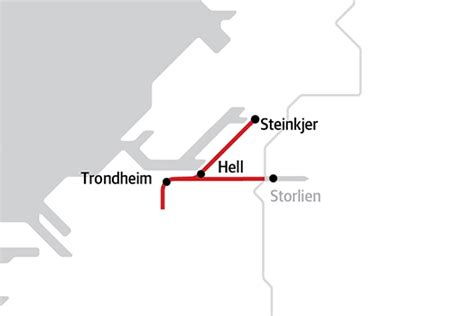
This simplified map shows the routes from Trondheim that head south (not mentioned further), east and north. Both of these last two routes run to Hell, on the south bank of the Stjørdal River. Across the river to the north is TRD = Trondheim Airport, Værnes and the city of Stjørdal. South of the river the line continues eastward commonly under the name Meråker Line, where it crosses the border into Sweden. The first station in Sweden is at Storlien. West of Storlien, diesel locomotives (Loks, in colloquial Norwegian) were used on this route, with electric locomotives taking over for the journey eastwards.
A Type 76 FLIRT train at Trondheim Airport, Værnes station. Photograph: Alasdair McLellan

Stadler, the Swiss train manufacturer, makes various models of FLIRT = Fast Light Intercity and Regional Train (English); Flinker Leichter Intercity- und Regional-Triebzug (German), multiple-unit trainsets. The Type 76, now used in Trøndelag, as a replacement for the Type 92, is a variant of these. It is 7.2 meters longer, with two drive bogies, compared to three on the other similar types, because of a generator car containing four power packs. Each power pack contain a 480 kW diesel engine and a generator that supplies electricity independently of each other. There is also a small battery pack that can be used to move the trainsets in and out of workshop buildings without starting the diesel engines.
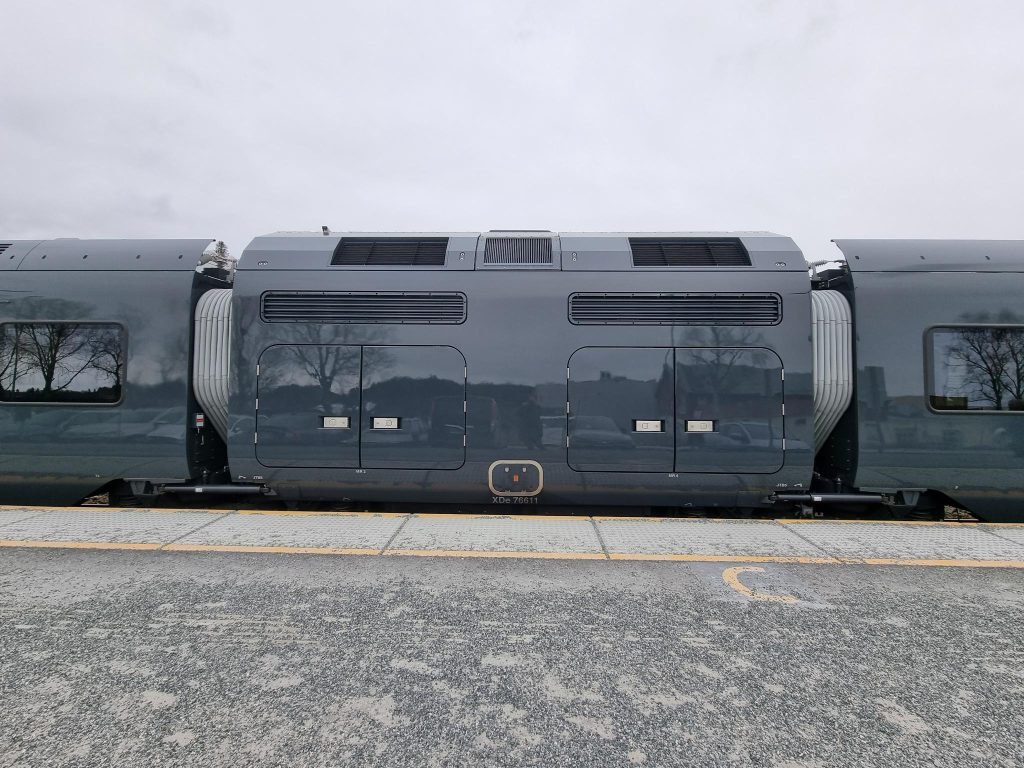
I refer to this unit as a Power Pod, essentially a half-length special purpose rail car, equipped with four power packs, each providing 480 kW of diesel fueled motive power to a Type 76 train. The photograph was taken at Røra station, Inderøy by Alasdair McLellan.

To discover new electrified rail adventures, we bought ourselves two books, one in English and the other in Norwegian: The newly (2022-04-12) published 17th edition of Europe by Rail: The Definitive Guide, by Nicky Gardner and Susanne Kries; Ferie med Tog: Reiseglede langs skinnene = Holidays by Train: Travel pleasure along the tracks (2022), by Sigrid Elsrud.

It is not practical to make rail journeys everywhere. For the first time since the pandemic, Brock is taking flights, to Iceland and the Faroe Islands. He and Trish are still intending to take flights to visit our daughter, Shelagh, currently living in Oakland, California. However, these could mark the end of our flying career that began, for Patricia, in 1966, when she returned from Ireland and Great Britain with her sister, Aileen. To get there, they had taken a train across Canada from Vancouver to Montreal, then taken a ship to Cork, in Ireland. Most of our international flights have involved trips to British Columbia, to visit family.

More

If one intends to do less of something, the time involved has to be applied to other activities. Less travel means more of something else. That something else means more of staying at home.

We live in a rural area, and have no intention of moving. We have lived in the same house since 1989-03-01. Most weeks I drive into Straumen, our municipal centre, and back, 26 km (16 miles). Once a month, I extend this to 60 – 70 km (32 – 37 miles) by driving to one of the neighbouring communities of either Verdal or Steinkjer. Patricia has even more extensive driving habits, that may involve driving 100 km in a week. Weather permitting, we make a few longer excursions. In 2022, we spent NOK 10 758.84 on diesel for our Mazda 5, and drove about 8966 km. The fuel costs were about NOK 1.23/ km (US$ 0.20/ mile).

Since 2023-02-13, Buzz, our Volkswagen electrified MPV, has been providing this service. After 80 days of use, we had driven 2004 km, which amounts to an average of slightly over 25 km a day. We had provided Buzz with 526.2 kWh of electricity. This costs us about 1.5 NOK per kWh = NOK 789.30. The fuel costs per km are about NOK 0.40/ km (US$ 0.065/ mile), which is about one third of that of the Mazda 5.

We had driven more with Buzz than I had originally anticipated, but it includes about 700 km of excursions. This would amount to about 9 200 km a year, or almost the same as we drove the Mazda, in 2022.

Reducing transportation impacts may be necessary, but it is not enough to prevent climate change. In many areas we have decided to make do with what we have.

An example: In 2012, we bought a used 40″ HD television for half its 2010 new price (NOK 2 500 vs NOK 5 000). Its TV reception capabilities were almost immediately eliminated to avoid the television reception tax. Instead, it is connected to a media player that, in turn, is connected to our server. The media player uses LibreELEC = Libre Embedded Linux Entertainment Center, a just enough operating system, that supports the Kodi media player software. Both of these are open-source products. This screen will not be replaced until it stops working. It is gudenuf for our use.

This is mentioned because our primary substitute for international travel involves viewing documentary films. We will allow younger, physically fit camera crews to endure the dangers of capturing remote places, and enjoy them in our living room, up to a maximum of one hour a day, and up to several times a week. Five hours of viewing a week, should be enough for anyone. For those who think that we waste our time with television, our total consumption in 2023, ending 2023-05-05 is less than 40 hours! Yes, we keep a complete log of all programs watched.

We often refer to our residence as a cottage, rather than a house. Definitions are often personal, and my definition of a cottage is a residence that is compact, rural, close to nature, simple and charming. One further requirement is that it has to be practical. One cannot live in a cottage without adequate laundry facilities. Wikipedia tells us: “A cottage during England’s feudal period, was the holding by a cottager (known as a cotter or bordar) of a small house with enough garden to feed a family and in return for the cottage, the cottager had to provide some form of service to the manorial lord. However, in time cottage just became the general term for a small house.” The term has its origins in old Norse, kot = hut. The modern Norwegian kott refers to a closet. Related to cot is the Latin domus = dwelling/ house, and grangia = barn. In time the grangia became the grange, referring first to a farm, and then to a large house.

By compact, I mean that rooms are small, yet functional. Rural refers to a low population density. It is more difficult to specify what close to nature actually means, since so much of nature has been destroyed, or cultivated. Sometimes it is simply a brownfield area that has been left to rewild. Simple? One has to be careful about definitions here. Someone might object to calling a dwelling simple, when it is wired with Ethernet cables everywhere, and shelters about 20 different computers. To side-step this issue, I will define simple as the absence of unnecessary decoration. Similarly, I will not even attempt to define charm, except to say one knows it when one sees it.

For better or worse, I am not sure everyone can adapt to cottage life. My parents retired to a new, but similarly sized dwelling on Vancouver Island. They lived there for twelve years, then returned to New Westminster, and lived two blocks from the house where I had grown up. In contrast, I have no desire to reconnect with the bustle of urban life. Online shopping holds greater appeal than in-person shopping, although I value visits to places where I can see and touch wood, as well as plumbing and electrical components!

Before retiring, I would attempt to hire people to renovate parts of the house. It was no great success, because I felt the workers were always trying to take shortcuts or not being competent to do what I asked them to do. Our main bathroom is adequate, but it is not equipped with the pipe-in-pipe plumbing, I requested. The roofer did not know how to apply roofing paper, resulting in a leaking roof. The carpenter did not optimize the use of boards, creating unnecessary waste. Since I retired I have rebuilt much of the cottage myself, but keeping it simple. This year, and for the first time since the cottage was built in 1963, the kitchen is being renovated.

At one point I reflected on my personal dependency on Ikea, especially with respect to my office. It is not always appropriate to make everything. I use an inexpensive, black Ikea Råvaror folding chair (no longer available), with a back and seat made of plywood, without arms. There are no adjustments. This is useful when I make things at my desk. Arms on a chair would just get in the way. When that gets too uncomfortable, I work standing up, folding the chair and stowing it, and raising the sit-stand desk I bought in 2008. It is not from Ikea, but from a local furniture store. It measures 1800 mm wide x 1000 mm deep (72″ x 40″). Along the wall behind my desk I have installed a shelf above the standing height of the desk, and fitted it with three Ikea Moppe mini-storage chests that houses components and tools. Above that I have 4 (width) x 2 (height) Ikea Eket storage cubes, for equipment, books and other reference materials. I also have an Ikea Alex drawer unit, for storage of things, including those printed on paper. More recently, I bought an Ikea Elloven monitor stand with drawer. The top of it supports my 27″ AOC monitor, Logitech G Pro headset and Vertical mouse. Underneath, it provides space to stow my Logitech K860 ergonomic keyboard, while the drawer provides storage space for assorted writing implements. I also have a desk lamp with magnifier, which is sometimes necessary for electronic work. If I need greater magnification, I also have a stereo microscope. I still use my 2016 Asus VivoMini VC65, because I like it. I deliberately bought a monitor without a camera, but have a Logitech webcam, for those few occasions when it is needed. In terms of speakers, I have an Angry Birds speaker bought used for $5. The power supply it did not come with, cost more! It is not used often, because I share my working environment with another person. This is also why I have never considered a mechanical keyboard. In terms of plants, I not only have Phillis, a philodendron, but curtains made from Ikea Filodendron cotton fabric.

While the kitchen has some components from Ikea, especially the Vattudalen sink and Sundsvik tap/ facet. Most of the whiteware is international: The Samsung microwave oven, fridge and freezer were bought in Steinkjer, in 2021; The Electolux dishwasher and oven, and the Husqvarna induction stovetop were bought locally in Straumen, in 2023. I have come to accept a certain level of dependency on large corporations. Much of the remaining components and supplies came from Biltema = Car Theme, in Steinkjer. It is yet another Swedish chain, founded in Linköping in 1963, to provide car parts to the Scandinavian market. In particular, they have provided the material for the cabinets, made from 18 x 600 x 2400 mm = 3/4″ x 2′ x 8′ spruce shelving material, and the 25 x 600 x 2400 = 1″ x 2′ x 8′ oak counter tops. They have also supplied PEX plumbing components, and electrical installation materials. The drawer and sliding door handles have a more complex history. Originally, we bought some at Ikea, but these were discontinued. However, an identical model soon appeared at Biltema. These have become the standard handle used throughout the house. They also provide a sense of continuity. None of these parts are cutting edge, but they are gudenuf!

Some

One of the main reasons I will continue to reduce the time I spend writing is because I want to spend some time doing other things. In 2022-06 I bought a CNC machine that still has not been used. I need to reassign time from writing to working in other areas. I need more variation.

For example, I want to construct a geodesic dome greenhouse, for the experience of making one. Afterwards, I may just give it away because gardening does not give me pleasure, and Trish does not want one. Similarly, I would like to use my CNC machine (and other tools) to construct a robotic lawn mower. Yes, I can probably buy one for less, but that won’t provide me with the satisfaction of making one. It may be based on a Segway Navimow, but with variations.

A Segway Navimow H3000E robotic lawn mower. Photo: Segway

There is now less than five hours before this post will be published. I have made some corrections, eliminated some content, and added some more. I will continue to publish some posts, but not with the same intensity as before.

Spiritual Growth! material sustainability

13 June 2009

“Spiritual Growth! material sustainability.” is my current motto.  Unfortunately, there has been far too much emphasis on economic growth, especially for those who have too much from before, and not enough demand for the one product where supply always exceeds demand – spirituality.   Since I’ve now passed my 60th birthday, it is probably time to start a blog.  My main concerns in life have to do with the survival of this planet.  Additional economic growth, will almost certainly place additional pressure on our planet’s ability to survive.  Additional spiritual growth, with its focus on God, will lead to a more harmonious life.

One work that examines the problem of unnecessary economic growth is “Prosperity without growth!” Unfortunately, most economists – as well as politicians – have ignored this problem.  Their only solution is growth whether it suits or not.