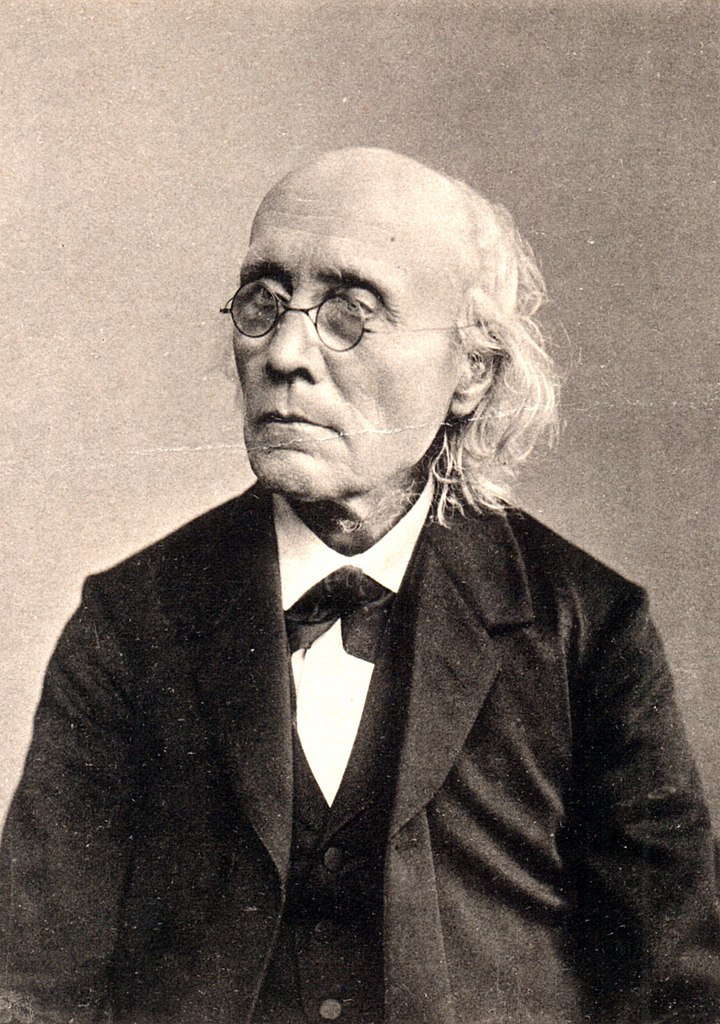
This weblog post is being published on Fechner day, 2024-10-22. It celebrates the day in 1850 when Gustav Fechner decided not to waste his life sleeping, and to make lasting contributions to psychophysics or, as some people call it, experimental psychology. People who want a basic understanding of his life may prefer to read a Wikipedia article about him.
There are two reasons why Gustav Fechner has impinged on my life.
First, one of my children is a grapheme-colour synesthete where letters and numerals are perceived as inherently colored. Synesthesia, more generally, involves perception where stimulation of one sensory/ cognitive pathway leads to an involuntary experiences in a second sensory/ cognitive pathway. Other examples include people experiencing colours/ tastes/ odors, when listening to music.
John Locke (1632 – 1704), in 1690 reported a blind man who said he experienced the colour scarlet when he heard the sound of a trumpet. There is disagreement as to whether this described an instance of synesthesia or was simply metaphoric.
There are two types of synesthesia. 1) projective: when a person sees colors, forms or shapes when stimulated. It is the most commonly experienced, and most widely understood version of synesthesia. 2. associative: when a person feels a very strong but involuntary connection between the stimulus and the sense that it triggers.
For example, in chromesthesia (sound to color), a projector may hear a trumpet, and see a red circle in space, while an associator might hear a trumpet, and think very strongly that it sounds red.
The first medical account came from German physician Georg Tobias Ludwig Sachs (1786 – 2014) in 1812. In 1876, Fechner sampled the general public to estimate the size of the population experiencing grapheme-colour synesthesia. A 2013 article in Scientific American puts the number of synesthetes at about 4% of the population.
I am also acquainted with Fechner in terms of three methodologies he developed for experimental psychology. These were developed to find out various thresholds for a population.
Method of limits. An ascending series of stimuli are presented, in which the intensity of a variable stimulus is increased by predetermined steps until it can be perceived on 50 per cent of presentations (for an absolute threshold determination) or until a difference between it and a standard stimulus can be determined.
Method of adjustment. A test person is given control of intensity levels of a stimulus and is instructed to adjust it to the level where it is barely discernible. An average is based on several trials.
Method of constant stimuli. Variable stimuli are presented in random order, with the objecting of finding the smallest intensity that can be detected involving absolute thresholds or the smallest difference from a standard stimulus that can be detected in the case of a difference threshold. Currently, correctly identifying 75 per cent of presentations for detection or discrimination is used to set limits.
What I find most interesting about Fechner is his nature, divided as it was between scientist and metaphysical philosopher. His career was an unsuccessful attempt to unite these sides.
On one side, Fechner was at heart a positivist, advocating observation and measurement in science. This encouraged an interest in phenomenology and verificationism in philosophy. On the other side, his interest in metaphysics demanded a comprehensive cosmology, unattainable through scientific investigation. As the Stanford Encyclopedia of Philosophy asks, in its article about him, but fails to answer: How could he be both a cautious and sober scientist and a daring and imaginative metaphysician?
It acknowledges that these two sides represent conflicting approaches, romanticism and empiricism. Of particular importance to him were the writings of Friedrich Wilhelm Joseph Schelling (1775–1854), Lorenz Oken (1779 – 1851) and Henrik Steffans (1773 – 1845) , where the emphasis was on a larger picture. However, since he was a student of physics and physiology at the University of Leipzig, he was influenced by his mentors, Alfred Wilhelm Volkmann (1801 – 1877) and Ernst Heinrich Weber (1795 – 1878), engaged in the experimental psychology of perception.
Positivist writing include a two volume work: Elemente der Psychophysik (1860) = Elements of Pyschophysics, parts of which were translated by Herbert Sidney Langfeld (1912) about the relationship between the psychic and physical. Because it stressed the dependence of the mental on its physical expression and embodiment, Fechner’s philosophy of mind has been categorized as materialism. Metaphysically, he is classified as a panpsychist, someone who believes the cosmos is psychic. For a modern, logical proof of this see this Wikipedia article which contains a summary of Thomas Negel’s (1937 – ) work on Panpsychism originally published in Moral Questions (1979). Fechner published his work on the subject in: Nanna oder über das Seelenleben der Pflanzen (1848) and Zend-Avesta oder über die Dinge des Himmels und des Jenseits (1851).
Fechner believed that metaphysics should follow, not lead, the empirical sciences. He believed these to be autonomous, with a foundation independent of philosophy.
Any attempt to understand Fechner must come to terms with both sides of his personality. Many studies of Fechner are one-sided, emphasizing one side of him at the expense of the other. Indeed, the view supported by many modern philosophers is that Fechner’s philosophy is incomprehensible without knowing about his life.
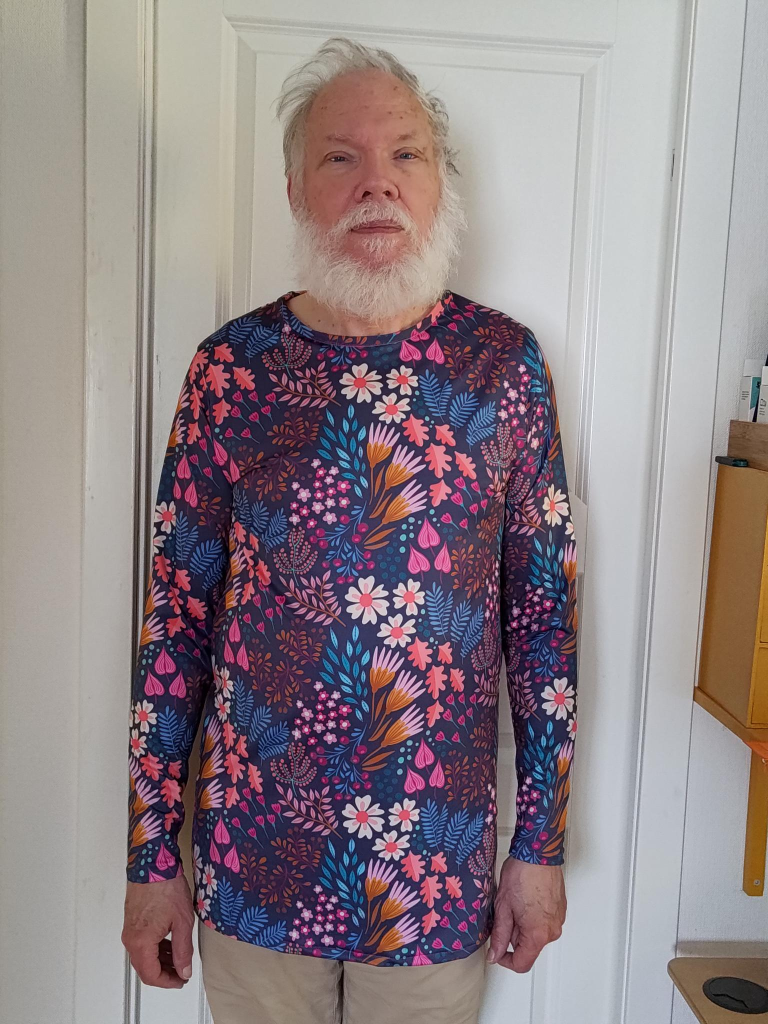
The writer of this weblog post dressed in a shirt from Thunderbird design. This was a bespoke replacement for a black shirt with geometrical shapes (triangles, rectangles and circles) in bright colours, purchased in the late 1960s, referred to then as the jazz shirt, that has disappeared in the intervening fifty plus years. This jazz shirt 2 is nothing like the original, but is appreciated for its organic patterns, bright colours and black background. It is 50% recycled fabric. Photo: Trish McLellan.
This post is about people who are ardent followers/ consumers of fashion trends. Yet, I also wanted it to include fashion producers, especially those working as artisans in studios, or serfs in factories. The title is Fashionista, despite the title being a letdown from my aspirations. It refers to avid leaders and followers of fashion. It has nothing to do with a modern line of Barbie-brand dolls with more body-shape options (curvy, petite, tall) than the originals.
My wish for those unfortunate fashion industry serfs, in Bangladesh and elsewhere, is that they be paid a living wage, hopefully more, and have a better work-life balance. The artisans could also appreciate these same benefits. For the individuals/ majority shareholders who own the large fashion houses, and some of their patrons, have more than enough income, I hope some form of limitarianism will reduce their incomes, wealth and indifference to human suffering.
People who do not fit into traditional social roles can suffer from outbreaks of mental illness. One category of problems involves deviant behaviors. Labels have led to people being given different forms of care (read: inhumane treatment), depending on the time and place, and social status. At the back of my mind, I recall reading about the situation in nineteenth century Britain, with asylums overfilled with a mixture of people. Some would be struggling with mental illnesses. Others were dumped there because their social or economic problems led them to being alienated from society. Later, in the 20th century, these patients would be subject to horrifying levels of abuse: typically lobotomies and electroconvulsive therapy. These therapies led to many other issues. Unsurprisingly, mental health (of workers or of clients) has rarely been covered by the fashion media.
Most work in the fashion industry is competitive. It allows fashion corporations to pay their employees less. Many participants are struggling with mental illness, especially trauma. Yet, it is difficult to find truthiness about this in the media. For some, fashion trauma is nothing more than a click bait term, to increase the sale of products and services. I came across one writer who thought that her poor mental health was her own fault for not buying the right things, garments especially. I think she imagined that having good mental health, was like being in good physical shape. The answer to a less than perfectly performing body is a gym membership. One does not actually have to work out in the gym, because everyone knows how much time-press people are subjected to. One does not have to measure one’s mass, because everyone knows there will be periods where that mass will increase. In the long-term, fat will be traded in for muscle mass! Deluded Belief 1: Gym membership is an important first step, towards possessing a new improved body.
Fashion, can assist on the journey to increase muscle mass. Some clothing items are more flattering than others. So, in addition to a gym membership, it is important to buy some stop-gap clothing that will conceal flab and other temporary imperfections. Deluded belief 2: When one has attained that more muscular body, clothing can be discarded, and real fashion items purchased.
Being a fashionista requires a re-disposition of time. One should show an interest in fashions, either be attending assorted fashion weeks, or watching videos about them; reading or, preferably, writing fashion books; attending fashion exhibitions or museums or even art galleries, where one can find historical fashion items either on display or totally lacking, depending on the art being viewed.
One learns that it is especially important to follow micro-trends. Otherwise, others might question one’s sincerity. Making frivolous purchases can be expensive, and whimsical, but real fashionistas will explain that this is precisely why credit cards were invented.
Relaxation is not a term used in the fashion industry. The fashion world doesn’t allow for downtime. Despite this, burnout has become a systemic issue, but perhaps not an approved discussion topic between fashion employees. Designers experience panic attacks since there is never enough time to complete a collection in the allotted time. Models have their eating disorders. Garment workers typically suffer from post-traumatic stress disorder (PTSD) related to unsafe working conditions. Others experience this mental and behavioral disorder from enduing a traumatic event, such as sexual assault, warfare, traffic collisions, child abuse, domestic violence, or other threats on a person’s life or well-being. Fashion school students are exhausted, while their teachers are depressed from having to deal with them. Only the mannequins seem to be resistant to mental health issues.
Fashion as a system means that those in the higher echelons of the fashion world are God’s gift to humankind, but those immediately and further below will never ascend, or even be good enough. Social media contributes by intensifying insecurities and by encouraging consumerism. An alphabet soup of people seek employment in the industry, but face additional challenges, some related to personal safety.
I also came across some interesting statements. For example, one person claimed that fashion was supposed to make people happy, and even encouraged people to dress-up at home! It was almost as if people were dressing for themselves, and not others. Sara Ahmed in The Promise of Happiness (2010), examined happiness through feminist, queer and racial study lenses. She questions if the popular conception of happiness is actually worth the sacrifices made. In particular, she explored how, now as well as in previous generations, the ideal of the happy housewife had been and still is being used to justify forms of gendered labour. According to Ahmed, the crisis of happiness is not the failure of traditional social ideals, but the failure to follow them.
When I look at my life in Norway, and compare it with my earlier life in Canada, I am a happier person. It is acceptable to be a mediocre person, and to do an adequate job. There is no need to excel. Six out of the top seven happiest countries in the world for 2024 were Northern European. Five of them Nordic. Finland was at the top with an overall score of 7.741, followed by Denmark (7.583), Iceland (7.525), Sweden (7.344), Israel (7.341), the Netherlands (7.319), and Norway (7.302). Other countries where other readers of this blog live (or have citizenship) include Australia: 10 = 7.06, New Zealand: 11= 7.03, Canada: 15 = 6.90, Ireland: 17 = 6.84, and USA: 23 = 6.73. With the exception of Iceland, that remained the same as in 2023, all of the countries mentioned here were on a downward trend.
To construct the index, researchers analyzed comprehensive Gallup polling data from 143 countries for the previous three years, specifically monitoring performance in six particular categories: gross domestic product per capita, social support, healthy life expectancy, freedom to make your own life choices, generosity of the general population, and perceptions of internal and external corruption levels.
Janteloven (Danish & Norwegian) = The Law of Jante (English), is a code of conduct used to express social disapproval of individuality and, especially, personal success. It comes from the work of Danish-Norwegian author Aksel Sandemose (1899 – 1965) first formulated as ten rules in his satirical novel En flyktning krysser sitt spor = A Fugitive Crosses His Tracks (1933). The attitudes are older.
Copenhagen Fashion Week
The Law of Jante is used to explain why, starting in 2018, Copenhagen Fashion Week announced that designers would have to adhere to a set of minimum sustainability standards, starting in 2023. These are:
Strategic Directions
We work strategically with embedding sustainability and international standards on human right
We include diversity and equality in our management approach and actively consider these aspects when hiring staff, especially for management positions
We do not destroy unsold clothes from previous collections
Design
We design to increase the quality and value of our products economically and materially and inform our customers about the value of longevity
We find a second life for our samples
Smart material choices
At least 50% of our collection is either certified, made of preferred materials or new generation sustainable materials, upcycled, recycled or made of deadstock
We have a preferred materials list in place
We have a list of restricted substances in place, following the requirements of the EU REACH Directive, and engage with our suppliers to ensure compliance
Our collection is fur-free
Working conditions
We are committed to exercising due diligence in our supply chain according to international guidelines and standards, and work with our suppliers to ensure e.g., freely chosen employment, secure employment or no child labour
We are committed to operating a safe, healthy and respectful working environment for all our employees, free from harassment and discrimination and where everyone enjoys equal opportunities regardless of gender, ethnicity, age, political/religious/ sexual orientation, physical appearance and ability
Consumer engagement
Our in-store and online customer service staff is well informed about our sustainability strategy
We educate and inform our customers about our sustainability practices on multiple platforms
We do not utilise single-use plastic packaging in store or for online orders but offer recyclable, recycled or repurposable alternatives
Showcase
Our set design and showcase production is zero waste
We do not utilise single-use plastic packaging backstage during fashion week but offer recyclable, recycled or repurposable alternatives
We offset or inset the carbon footprint of our showcase
We are signatory of the Danish Fashion Ethical Charter and consider diversity and inclusivity when casting models
In 2024, Copenhagen Fashion Week made updates to the framework. It still comprises the six focus areas attempting to implement a holistic approach. Marie Busck, responsible for the framework, commented: The revisions of the requirements are important. We need to ensure that the framework reflects the developments of the legal landscape for fashion and textiles which currently is unfolding from the EU. In addition, we are also keen on integrating the valuable learnings from applying the framework and the input received from other stakeholders, making actions more clear and concise.
Some of the things I have noted are the absence of fur, along with discussions of the appropriateness of faux fur, made of petroleum products. There was also recognition that women, including models, could become pregnant which could affect their appearance. To be relevant, fashion has to incorporate people of all ages. This means that the family, as well as the individual, has to be taken into consideration. This means making products for children of assorted ages from birth onward, and even spouses. I think it was already acknowledged that women worked, and that people lived in climates that experienced winters.
Manifestations of sustainability included: the elimination of waste, unrecyclable seat cards or set pieces that can’t be reused; and, designs should use at least 50 percent recycled materials.
An anonymous crusader set up a scarecrow-like sculpture wearing a Make Less t-shirt and a grumpy frown outside several shows. The most sustainable approach would be to shut down Fashion Week. Eszter Áron of Aeron integrated her sourcing team into her design team so the two could be intertwined from the start, ensuring that material considerations were given equal weight to the designers’ imaginations. Rotate shifted 60 percent of the sequins in its latest going-out lineup to preferred materials that sparkled just as much. It’s creative directors Jeanette Madsen and Thora Valdimars, tapped Danish and Dutch universities to help them research new production techniques that won’t dim their sparkle. OpéraSport cofounder Awa Malina Stelter said her label’s first collection in 2019 already met Copenhagen’s 2023 standards, with organic, GOTS (The Global Organic Textile Standard)-certified cotton and other fabrics made from 90 percent industrial waste. Stine Goya of her namesake label, commented: If anything, moving toward more sustainable practices makes the design process more exciting and brings a new dimension to our work.
Copenhagen Fashion Week may be well-intentioned, but the result is more nuanced (read: less than perfect). Responsibly-sourced materials is a vague term, and can be interpreted in many different ways. Similarly, 50 percent recycled materials says nothing about the appropriateness of the materials used.
Chana Rosenthal, principal and founder at reDesign, commented: The vagueness actually makes it more appealing in a way to brands, because part of the [sustainability] challenge has been brands saying they’re doing something and then they’re not actually doing it. But also, it takes time. This isn’t something that’s easy to transition.
Lisa Bergstrand, founder of Bergstrand Consultancy, a firm that advises brands on sustainability initiatives, said: For there to be meaningful change in the long term, I think a closer look needs to be taken at fashion’s focus on trends, which is one of the biggest drivers of overproduction and overconsumption.
Standardized environmental checks seem the most promising path to encourage suppliers to shift their priorities in a way that makes more eco-conscious production accessible.
One of the major problems is that of scale. Fashion houses are wanting to produce profits for shareholders. That is not a concern of mine. I am more interested in workers being able to live off their work, without mental health issues. Thus, I am a supporter of the 国潮 (Chinese) = Guochao (English) movement, a trend of preferring homegrown designers which incorporate aspects of Chinese history and culture. This applies specifically to Gen Z buyers, but there are caveats, and pushback that impede its wider adoption. Issues include subpar quality, plagiarism, and high prices.
Closing notes
My fashion career began early, as a child model, with photographs even appearing in some forgotten Vancouver area newspaper! These days, my aspirations never exceed a faint hope that someone, anyone will regard me as being unusually, but pleasantly dressed, as I enter the local co-op. My current aspirations never exceed the geographical boundaries of Inderøy municipality, and its population that has finally reached 7 000 residents.
As my more intimate friends know, I faced taboos about wearing assorted colours in my childhood. It might be easier to list those I was allowed to wear: blue, grey and brown, with white shirts and undergarments. I had ample yellow rainwear, since it was visible. In strictness order, I was forbidden to wear: green, black, purple, red and orange, In general, these sanctions were not applied to tartans.
Since I live in Inderøy I attempt to support local companies: Husby Optics (founded 1854-10-04 – 170 years ago, last week) for eye wear, Thunderbird Design, for most of my clothing needs, and Kornelia smykker og design, for jewellry.
Lately, I have begun to question if I really am a normcore person. Wikipedia tells us: Normcore wearers are people who do not wish to distinguish themselves from others by their clothing. This does not mean that they are unfashionable people who wear whatever is easiest, but rather that they consciously choose clothes that are functional and undistinguished. The “normcore” trend has been interpreted as a reaction to ever-changing fashion trends, as normcore clothes are generally seen as timeless and unaffected by trends. Normcore clothes are unisex and are usually casual items such as hoodies, T-shirts, polo shirts, short-sleeved buttoned shirts, sweatpants, chinos, jeans, shorts, and sneakers; items such as suit jackets, ties, blouses, boots, and dress shoes are avoided.
On that list I only wear chinos regularly, but I also wear long-sleeved buttoned shirts (with two pockets). That said, I have several suits that have spent my retirement years hanging in a closet. My favourite is made of Donegal tweed, tailored by Kevin and Howlin, Nassau Street, Dublin, some years before the new millennium. I have no objections to being buried in it, along with a shirt recently made by Trish, but without a tie, I don’t know if dead people wear shoes in their coffins, but I have a pair of bright green Allbirds that will do nicely, if required. Yes, burial clothes are a person’s last opportunity to make a fashion statement. Select the garments wisely!
It would be heart warming to write that the the first transatlantic cable between Europe and north America landed at Heart’s Content on the Bay de Verde Peninsula, in Newfoundland. Unfortunately, it wasn’t, as described below. Despite this, Heart’s Content is world famous for the second trans-Atlantic telegraph cable, one laid between Heart’s Content and Valentia, Ireland. It was this cable that lead to the establishment of the Heart’s Content Cable Station.
Today’s weblog post is less about our visit to Newfoundland, and Heart’s Content, than it is about the history of connecting two continents with communication cables.
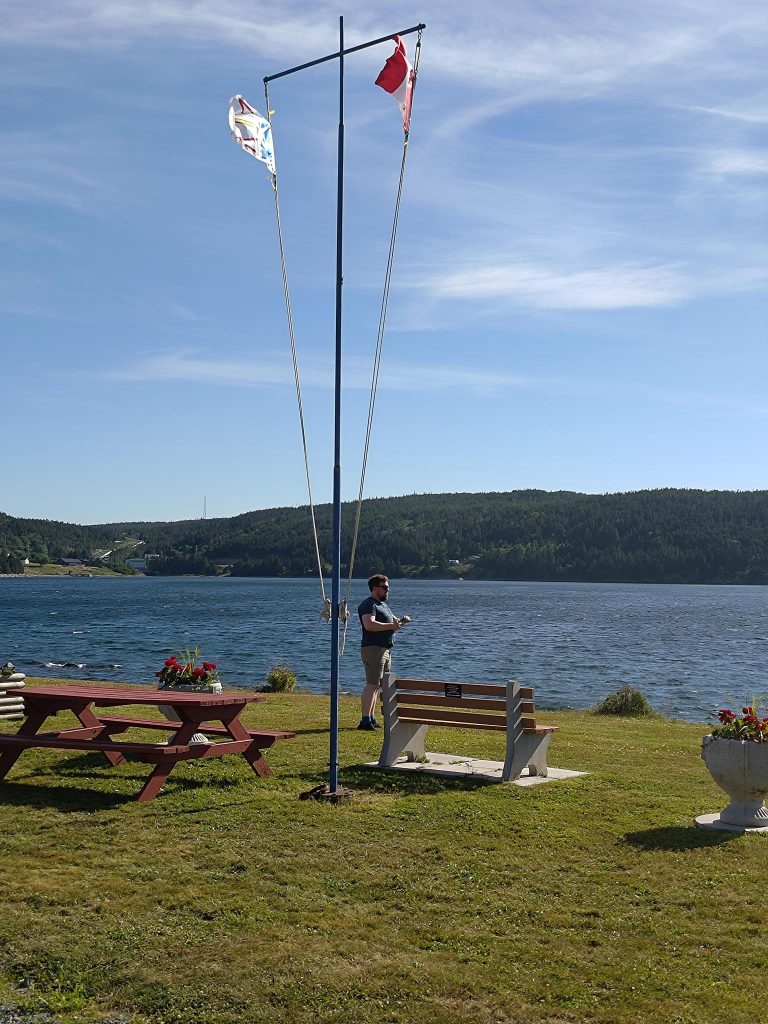
Alasdair at the park in front of the Heart’s Content Cable Station.
Preface
It is difficult to state, with any degree of precision, the person and date for the invention of the telegraph. There are just too many things and people involved, including an electrochemical telegraph invented by Samuel Thomas von Sömmerring (1755 – 1830) in 1809. He also worked with undersea communication cables in 1811, when he and Pavel Schilling (1786–1837) made a trial with a wire cable which was sheathed in rubber, in Munich.
Samual Morse (1791 – 1872) gets credited with the invention not only of the machinery used, known as the one wire telegraph, from 1837, but for the code used to transmit messages. There inventions competed with others, such as one by William Fothergill Cooke (1806 – 1879) and Charles Wheatstone (1802 – 1875) who invented and patented a needle telegraph in 1837. The receiver consisted of a number of needles that could be moved by electromagnetic coils to point to letters on a board. This feature was appreciated by early users who were unwilling to learn codes, and employers who did not want to invest in staff training. In 1838 they installed the first commercial telegraph, on the Great Western Railway, running 21 km from Paddington station to West Drayton. It was a five-needle, six-wire system. It was far too complex to be reliable.
In 1838 William O’Shaughnessy (1809 – 1889) lay an underwater cable across the River Hooghly at Calcutta. He covered his wire with pitch, then enclosed it within a split cane and wrapped tarred yarn around the outside. Charles Wheatstone later and independently developed a similar system.
In 1842 Samuel Morse transmitted an electric current under New York Harbour. The wire was insulated with tarred hemp and an outer sheathing of rubber. In 1845, Ezra Cornell (1807 – 1874) lay two copper wires, enclosed in cotton and insulated with rubber, then placed in a lead pipe, across the Hudson River between New York and Fort Lee. It worked initially, but was damaged beyond repair by drifting ice in 1846. Also in 1846, Charles Samual West (1809 – ca. 1889) succeeded in transmitting telegraph messages to a ship in Portsmouth Harbour, England, through a rubber insulated wire. In 1842, Samuel Morse lay an underwater cable in New York Harbor and succeeded in sending messages across it. A few years later, Ezra Cornell placed a telegraph cable across the Hudson River from New York City to New Jersey.In 1842, Samuel Morse lay an underwater cable in New York Harbor and succeeded in sending messages across it. A few years later, Ezra Cornell placed a telegraph cable across the Hudson River from New York City to New Jersey.
In the late 1840s Werner von Siemens (1816 – 1892) invented a machine for applying gutta-percha (a type of rubber) to wire.
In 1850, 25 nautical miles (nm) = 46 km of cable from the Submarine Telegraph Company was lain from Dover to Calais. It soon failed, because it wasn’t armoured. The company then ordered, a new, larger cable with four insulated cores, that was armoured before laying. This cable became the first working oceanic submarine cable.
Heart’s Content & the Trans-Atlantic Telegraph Cable
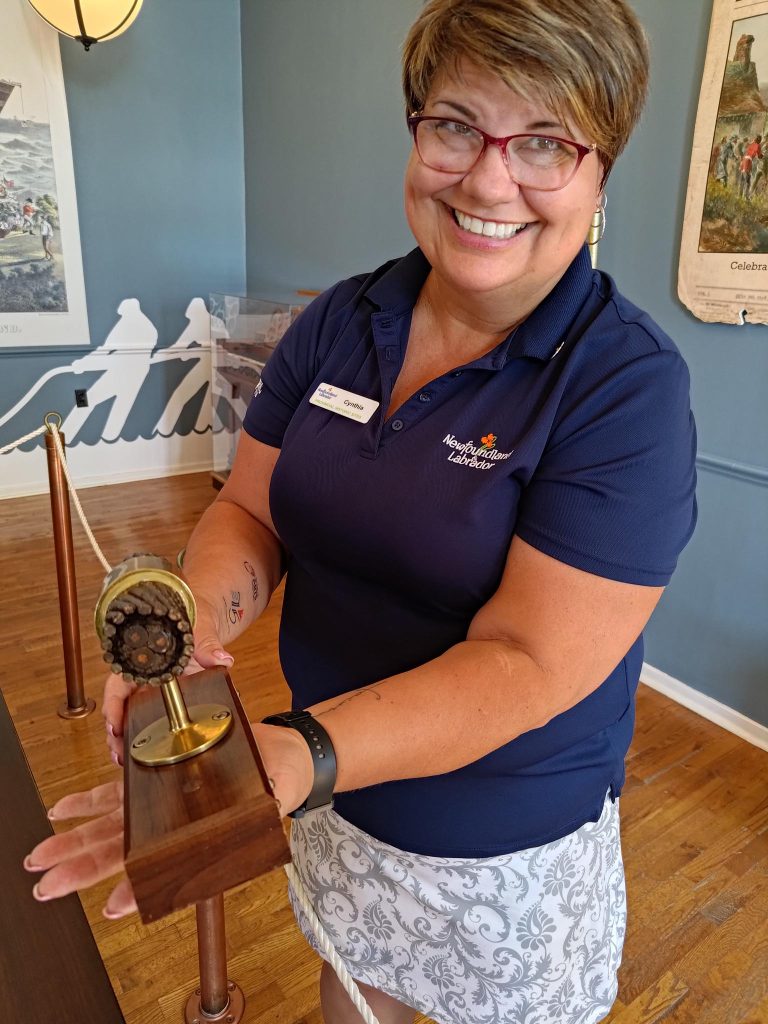
The key to getting a personal guided tour of the Cable Station at Heart’s Content is to arrive late. Here is Cynthia doing her best to get rid of me, before closing time.
Heart’s Content owes much of its reputation to the American businessman Cyrus Field (1819 – 1892) who in 1855 chose Trinity Bay as the terminus of his Transatlantic telegraph cable. Originally, the landing site was to be at Bay Bulls Arm, directly across Trinity Bay from Heart’s Content. It arrived there on 1858-08-05. However, due to a malfunction, its operation broke down after three weeks, and was terminated on 1858-10-20. On its first day of operation, Queen Victoria sent President James Buchanan the first message in Morse code.
On Friday, 1866-07-13, the Great Eastern left Valentia, Ireland with 2 730 nautical miles (nm) = 5 056 km of cable in her hold. On 1866-07-27, 1 852 nm = 3 430 km of this cable lay at the bottom of the Atlantic ocean, while the Great Eastern was anchored in Trinity Bay. The cable was laid at a rate of 5.5 nm/ hour = a speed of 5.5 knots = about 10 km/ hour.
This was the fifth attempt in twelve years to establish a transatlantic telegraphic link. Cyrus Field consulted with oceanographer Matthew Maury (1806 – 1873), about the feasibility of connecting Ireland with Newfoundland, and with Samuel Morse (1791 – 1872) about other aspects of its technical feasibility. Once those questions had been Field sought financial backing in New York from Chandler White (? – ?), Peter Cooper (1791 – 1883), Marshall Roberts (1813 – 1880) and Moses Taylor (1806 – 1882), founding with Cyrus and Dudley Field (1805 – 1894) the New York, Newfoundland, and London Telegraph Company. Submarine cables were laid between Cape Ray, Newfoundland, and Cape Breton Island, Nova Scotia, and then between Cape Breton Island and the Nova Scotia mainland. Thus,St. John’s, Newfoundland, and New York City were connected in 1855.
Field and nine associates then formed the American Telegraph Company (ATC). By mutual agreement with other telegraph companies, regional operating boundaries were established, with Newfoundland, Nova Scotia (?), New Brunswick, and the United States’ eastern seaboard became ATC’s territory.
The next several months were spent in establishing the Atlantic Telegraph Company, choosing the cable design, manufacturing the cable, finding backers, and securing support for the project from both the British and American governments. Note: It must be remembered that, at the time, Newfoundland was not part of Canada, but British territory.
Cable laying attempt 1: On 1857-08-05, the American steam frigate Niagara and the Royal Navy’s steamer Agamemnon left Valentia Bay, Ireland. Each held half-an- ocean’s length of cable. However, after laying about four hundred nm = 640 km, of cable the line snapped, and could not be recovered from the ocean floor.
Improvements were made to the machinery for laying the cable, a better insulating compound was developed, William Thomson invented a mirror galvanometer, used to detect cable signals, and still more capital was raised. The cable was stored on the docks at Plymouth, England. This was reloaded onto the Niagara and the Agamemnon.
Attempt 2: The ships left Valentia on 1858-06-10. Only 160 nm of cable were laid when it broke.
Attempt 3: Field pushed to try again immediately. The two ships met in mid Atlantic ocean on 1858-07-29, spliced the cable, then laid the cables in opposite directions. Both reached their respective ports in Newfoundland and Ireland on 1858-08-05. The cable was inoperable by 1858-09-18.
There was little interest in reviving the cable laying venture in either Britain or USA. The British Board of Trade set up a special commission to investigate submarine cables, that was active in 1859 and 1860. Members of the commission included Charles Wheatstone and Latimer Clark (1822 – 1898). They carried out experiments on the construction, insulating, testing, and laying of cables. Their conclusion was… a well-insulated cable, properly protected, of suitable specific gravity, made with care, and tested under water throughout its progress with the best known apparatus, and paid into the ocean with the most improved machinery, possesses every prospect of not only being successfully laid in the first instance, but may reasonably be relied upon to continue for many years in an efficient state for the transmission of signals.
By this time, the British government had lost interest in the cable project, and the United States was in a civil war. Despite this, in 1862 Glass, Elliott and Co. offered to make and lay the new cable and to put up $125,000 as well, in return for reimbursement of materials and labor costs, plus an additional 20% of the cost of the line. With this, Field found private investors in Britain and USA to raise the necessary capital, with London railroad entrepreneur Thomas Brassey (1805 – 1870) being critical, encouraging Manchester industrialist John Pender (1816 – 1896) and the Gutta Percha Company to form Telegraph Construction and Maintenance (TC&M) responsible for all aspects of the cable’s construction and the remaining necessary capital.
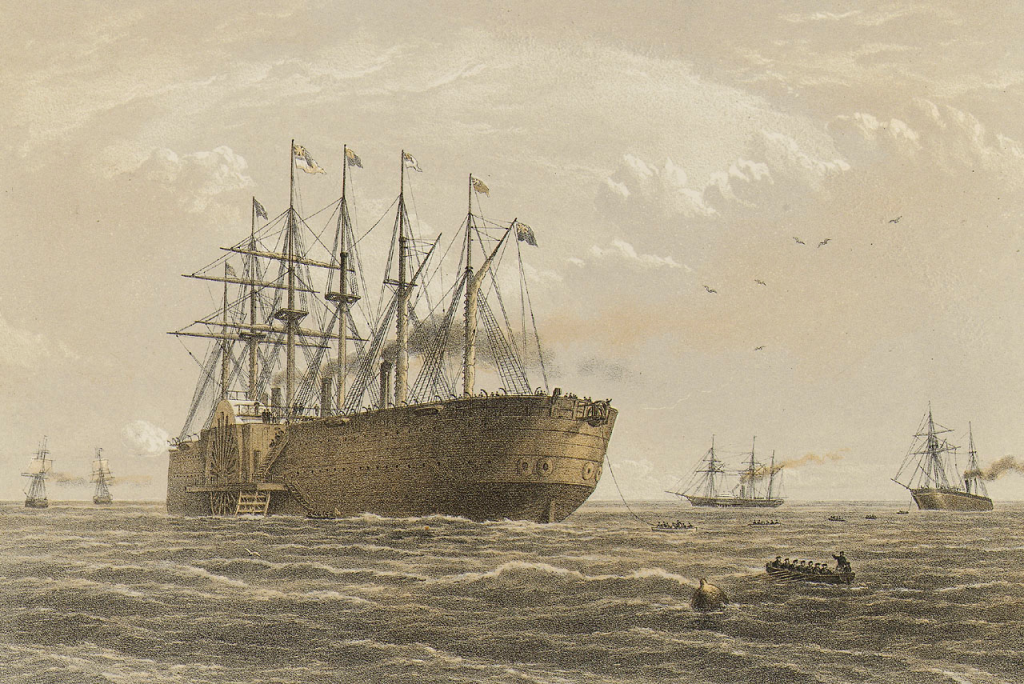
This print was made by Robert Dudley (1826 – 1909), official artist at work on the Great Eastern under the direction of its captain, James Anderson (1824 – 1893): His task was to record in the form of an illustrated book the minutiae of the voyage, charting in detail the technical processes, life on board, the movements of the ocean, departures and arrivals and (it was hoped) a successful outcome. This photo shows the SS Great Eastern starting to lay the trans-Atlantic telegraph cable in 1865-07-23 at Valentia, Ireland. Also shown are other ships involved in the cable laying process: Terrible, Sphinx, Hawk & Caroline. Of particular interest in the mechanism used to pay out the cable on the Great Eastern.
The SS Great Eastern was an iron sail-powered, paddle wheel and screw-propelled steamship designed by Isambard Kingdom Brunel (1806 – 1859), and built by John Scott Russell (1808 – 1882) & Company in London, but registered in Liverpool. It was in service from 1859 to 1889: length = 211 m, beam = 25 m, draft = 6.1 – 9.1 meters (load dependent), with a maximum displacement of 32 160 tons = 29.175 Gg, with a double hull and initially with sufficient coal bunkers giving it a range of about 11 000 km. Sources vary on how much this was later reduced, but it needed a range exceeding 4 000 nm = 7 500 km to cross the Atlantic. The Great Eastern captured the popular imagination as the largest ship afloat until the RMS Celtic (1901 – 1928). Because the Great Eastern had always lost money, she was auctioned in 1864-01, The purchaser was Daniel Gooch (1816 – 1889) who, with the financial help of Field and Brassey, bought the Great Eastern for $125 000. It had cost over $6 million to build. It was put at the disposal of the cable laying expedition. Note: The 1800s saw the GBP to USD exchange rate to be about GBP 1 = ca USD 5, except during periods of war. The GBP 1 was as low as USD 3.62 during the Napoleonic wars (1803 -1815), but as high as USD 10 during the US Civil war and its aftermath (1861 – 1875).
Attempt 4: On 1865-07-23, the Great Eastern lay cable manufactured according to higher technical specifications. Yet, the cable once again snapped and was lost only 1 000 km from Newfoundland. The improved methods of making and laying the cable were proven sound, and there was less skepticism about any next attempt failing.
Attempt 5: Capital was raised, the Anglo-American Telegraph Company formed, a new cable was constructed, the Great Eastern began laying cable on 1866-07-13 and on 1866-07-27, the cable was landed and began operating at Heart’s Content. The Great Eastern then returned to the location where the 1865 cable had been lost, retrieved it, spliced it, and paid out the remaining distance to Newfoundland. By 1866-09-08 two telegraph lines were sending messages across the Atlantic.
With it’s location on the east coast of Trinity Bay, Heart’s Content is better sheltered from storms, proving itself to be a good location for operating the trans-Atlantic cables. Two more cables were laid from Valentia to Heart’s Content in 1873 and 1874, then another two in 1880 and 1894.
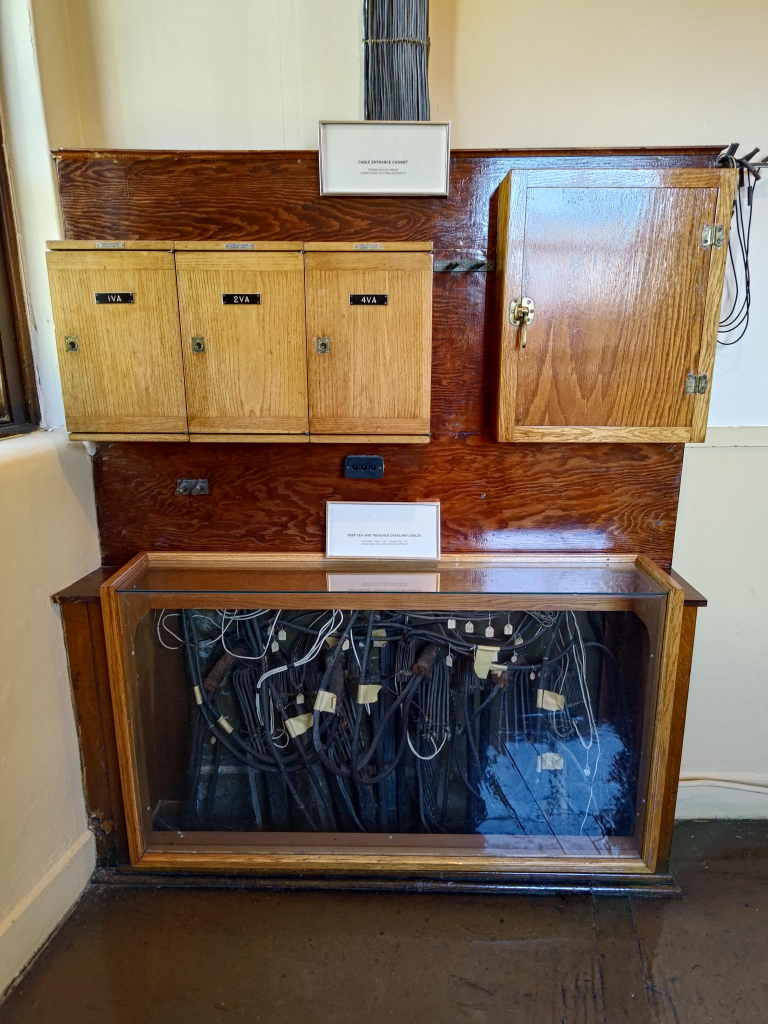
After landing at Heart’s Content, it is then sent to the Cable Station, which the signals are processed.
Messages arriving at Heart’s Content, had to be sent onward to New York and elsewhere. Field also provided a cable from Newfoundland to Baddeck, Cape Breton Island, where a telegraph house was built in 1861 that contained the Trans-Oceanic Cable Company office.
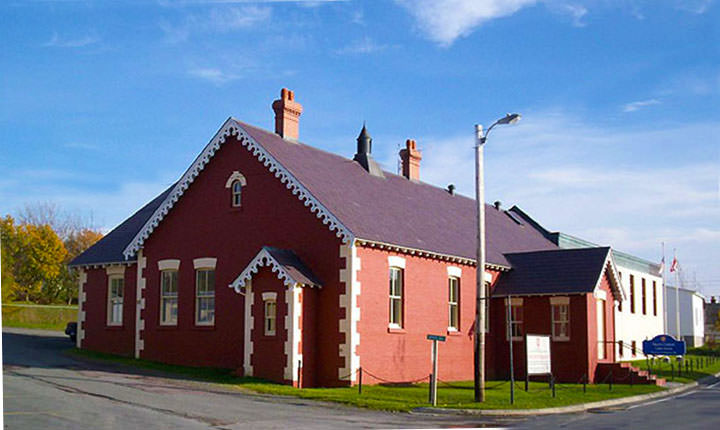
In 1918 the cable station was enlarged to serve increased communication volume of the Anglo-American Telegraph Company’s successor, Western Union, that had taken over the business in 1912. The station lasted until 1965, when it closed. Much of the reason for this closure was the replacement of telegraph with telephone. In 1968, the cable building was bought by the Newfoundland Government as an historic site, to be transformed into a communications museum. On 1974–07-27, 108 years to the day, after the 1866 landing of the transatlantic cable at Heart’s Content, the museum officially opened. We visited the museum 50 years and 3 days later = 2024-07-30!
Heart’s Content Cable Station
The Canadian and the Republic of Ireland governments want to create a transboundary World Heritage Site consisting of both the station at Heart’s Content and the station on Valentia Island. On 2022-12-20, Heart’s Content Cable Station and Valentia Cable Station were officially submitted to the UNESCO as a site entitled Transatlantic Cable Ensemble.
A reply from Tara Bishop, Site Supervisor at the museum: Generally all visitors are offered a guided your of the exhibit unless there is a time constraint that doesn’t allow ample time to do so.
Clarenville & TAT-1
The first radio-based transatlantic telephone call that began at 9:35 (New York time; 14:35 London time) on 2027-01-07 from the 26th floor of the AT&T building, 125 Broadway, New York City. It traveled over 5 000 km, via wire to a radio transmitter at Rocky Point, Long Island, New York State and then by radio waves to a radio receiving station at Rugby, England, then onward by wire to London. The return conversation went from London via wire to Cupar, Scotland, from there via radio waves to a receiving station at Houlton, Maine, and finally by wire back to New York City. This inaugurated In 1927 a 3 minute call cost £9 = ca US$45. The purchasing power of US$1 = US$18 in 2024, = US$ 810 for a 3 minute call. This system handled slightly more than 800 calls a day.
The main challenges with increasing traffic volume were technology related. Many advances came with developments during World War II. These included: coaxial cable, polyethylene insulation (replacing gutta-percha), reliable vacuum tubes for submerged repeaters and a general improvement in carrier equipment. Transistors were not considered since they were a recent invention with unknown longevity.
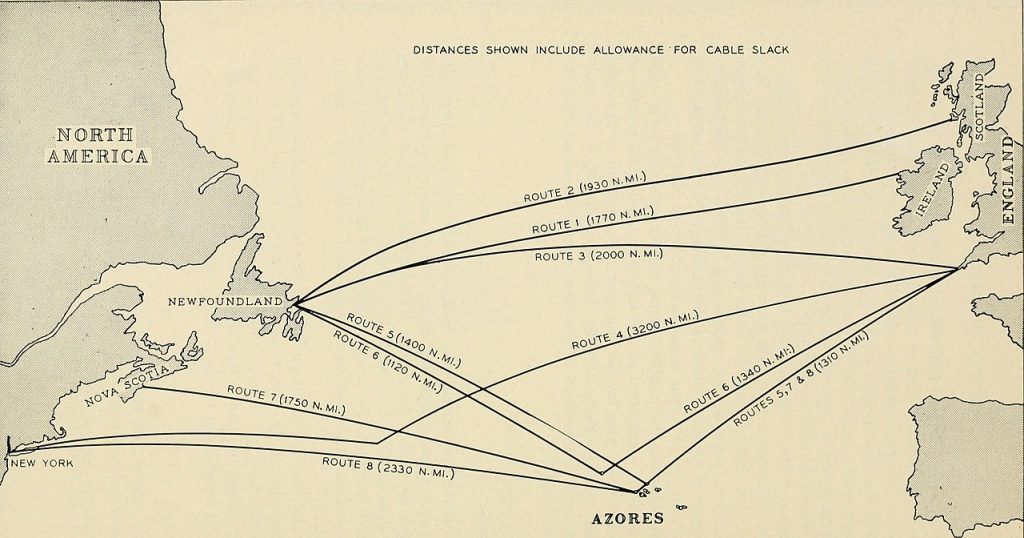
Route 1 was used for the trans-Atlantic telegraph cables, Route 2 was used for the TAT-1 telephone cables. Image: Bell Telephone System.
In North America, after a 1952 submarine telephone cable proved successful between Florida and Cuba, discussion emerged about a cable between North America and Europe in 1953, with the North American end ultimately proposed to be Clarenville.
There were to be two main cables, one for each direction of transmission. Each cable was produced and laid in three sections, two shallow-water armored sections, and one continuous central section 1,500 nautical miles (2,800 km) long. The electronic repeaters were designed by the Bell Telephone Laboratories of the United States and they were inserted into the cable at 37-nautical-mile (69 km) intervals – a total of 51 repeaters in the central section.
Clarenville was a junction on the Newfoundland Railway, that operated from 1898–1949 when it was merged into the Canadian National Railway (CN), before it was abandoned in 1988. The junction resulted in a branch line to the Bonavista Peninsula, from the main line. The construction of the Trans-Canada Highway through the community, completed in 1965 helped it become a service centre for central-eastern Newfoundland, serving 96 000 people, in 90 communities within a 100 km radius. There are claims that about 70% of Newfoundland & Labrador’s population live within two hours of Clarenville.
TAT-1, the first submarine transatlantic telephone cable system, was laid between Clarenville and Kerrera, Oban, Scotland. Two cables were laid between 1955 and 1956 with one cable in each direction. It was inaugurated 1956-08-25. Each cable was able to carry 35 channels = simultaneous telephone calls. A 36th channel could carry up to 22 simultaneous telegraph messages.
At the land-end in Gallanach Bay near Oban, Scotland, the cable was connected to coaxial (and then 24-circuit carrier lines) carrying the transatlantic circuits via Glasgow and Inverness to the International Exchange at Faraday Building in London. On the other end, from Clarenville a terrestrial line carried signals about 100 km to Terranceville, where another 480 km long submarine cable crossed the Cabot Strait ending up in Sydney Mines, Nova Scotia. From there the communications traffic was routed to the US border by a microwave radio relay link, and in Brunswick, Maine the route joined the main US network and branched to Montreal to connect with the Canadian network.
In 2024, 35 simultaneous conversations is not impressive. Yet, I find the speed of cable-laying impressive, 6 knots = 11 km/h, despite it being just marginally faster than that of 1865 = ca. 10 km/h.
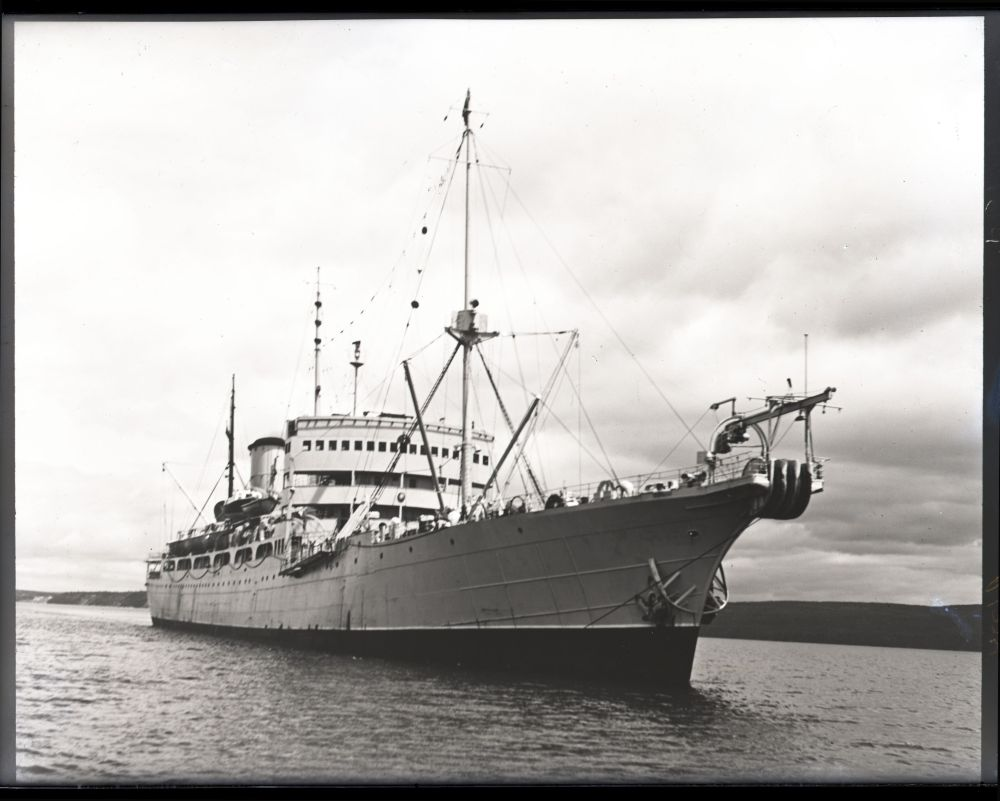
The cables were laid over the summers of 1955 and 1956, with the majority of the work done by the cable shipHMTS Monarch. At the land-end in Gallanach Bay near Oban, Scotland, the cable was connected to coaxial (and then 24-circuit carrier lines) carrying the transatlantic circuits via Glasgow and Inverness to the International Exchange at Faraday Building in London. At the cable landing point in Newfoundland the cable joined at Clarenville, then crossed the 300-mile (480 km) Cabot Strait by another submarine cable to Sydney Mines, Nova Scotia. From there the communications traffic was routed to the US border by a microwave radio relay link, and in Brunswick, Maine the route joined the main US network and branched to Montreal to connect with the Canadian network.
HMTS (later Cable Ship) Monarch, the 5th cable-laying ship of that name, as she appeared in 1956. Photo: General Post Office, owner of the vessel, at the time.
Opened on September 25, 1956, TAT-1 carried 588 London-US calls and 119 London-Canada calls in the first 24 hours of public service.
The original 36 channels were 4 kHz. The increase to 48 channels was accomplished by narrowing the bandwidth to 3 kHz. Later, an additional three channels were added by use of C Carrier equipment. Time-assignment speech interpolation (TASI) was implemented on the TAT-1 cable in June 1960 and effectively increased the cable’s speach capacity from 37 (out of 51 available channels) to 72.
TAT-1 carried the Moscow-Washington hotline between the American and Soviet heads of state, using a teleprinter to avoid misinterpretations. This link became operational on 1963-07-13, motivated by communication delays during the Cuban Missile Crisis.
Other TAT cables were subsequently laid. TAT-1 was retired in 1978.
Back in Norway, I started to read Arthur C. Clarke’s (1917 – 2008) Voices Across the Sea (1974, 2nd edition). I am glad that it was not the first edition from 1958, because the second edition looks at the future of transoceanic communication, including the use of satellites. Fortunately, for the world, there is unexpected progress. In 2024 people read fewer books, but rely on websites.
For me, as a technologist, that includes sites with a focus on fibre cables, possibly without even mentioning satellites. My choice of a website is: https://atlantic-cable.com/ No, it is not just about transatlantic cables, but undersea communication, generally. Its subtitle is: History of the Atlantic Cable & Undersea Communications from the first submarine cable of 1850 to the worldwide fiber optic network.
Connections: In 2000, my wife, Trish, and I visited Field, British Columbia, home to about 170 souls in the Kicking Horse River valley within Yoho National Park. It is 1 256 m high, and 27 km west of Lake Louise on the Trans-Canada Highway. It was named for Cyrus West Field. The purpose of our visit was to visit the Burgess Shales, a fossil-bearing deposit noted for the exceptional preservation of the soft parts of its 508 million years old (middle Cambrian) fossils.
Newfoundland & Labrador Conclusions
This is the last of the series about Newfoundland & Labrador. At some future date, I hope to publish a weblog post with recommendations for visiting Newfoundland, especially for people with an interest in transportation and communication, including amateur radio operators.
At the end of the trip, Alasdair answered some questions. These are followed by my own answers.
Did I enjoy the trip to Newfoundland? Yes. / Yes. Will I be back? I doubt it. / No. Would I recommend it? Not really. / It is for people with specific interests.
Alasdair concludes: The problem is that although there are some very quaint and interesting things to see, they are hundreds of km from each other. Most of the other tourists we saw and met were seniors. Strikes me it’s a place to go when one has been everywhere else.
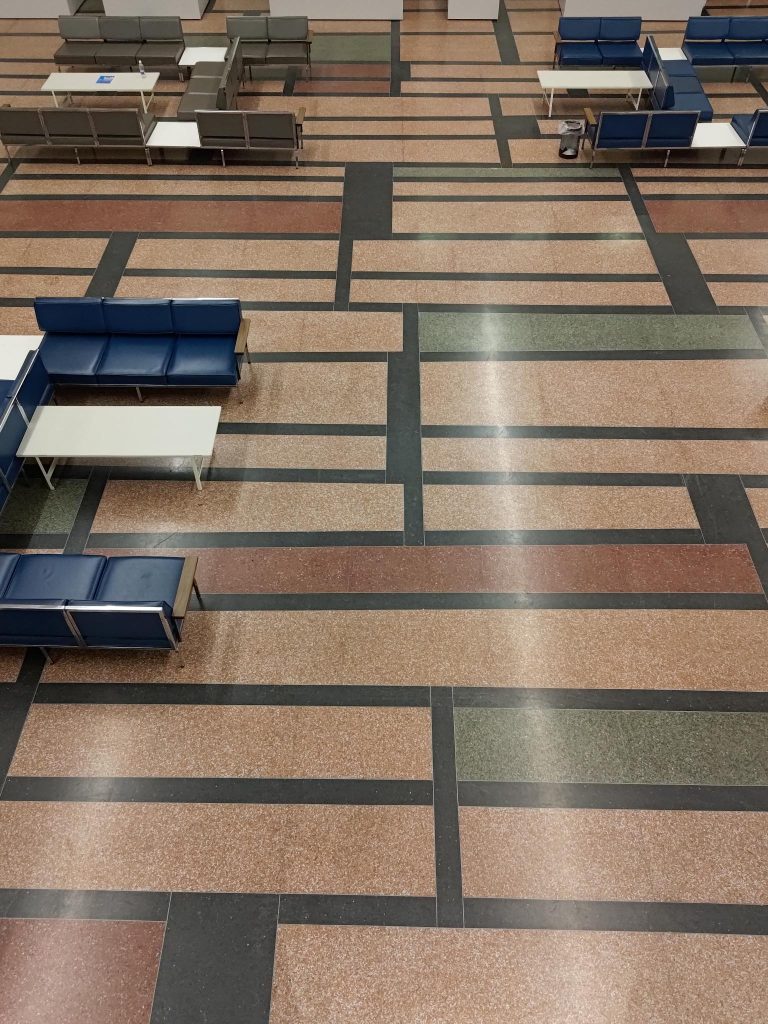
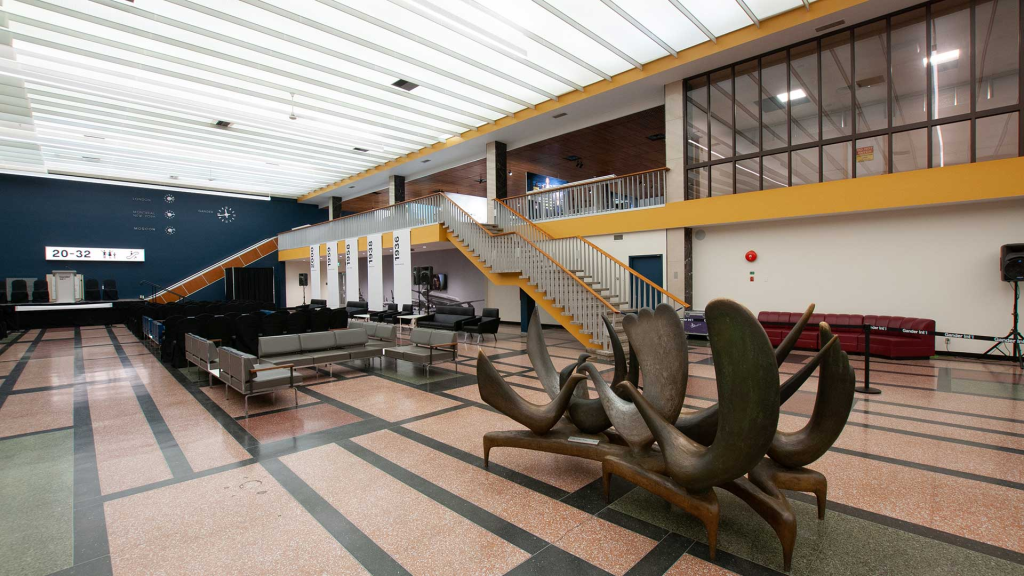
YQX International Lounge in 2024, reflecting how it looked when it opened in 1959.
At Cliff Cottage it is common to use the IATA airport codes to denote an airport location. YQX refers to Airlandia, sorry that suggested name from Ottawa was never used, Gander! The Crossroads of the World, in Newfoundland. A gander is an adult male goose. Before one thinks of some testosterone fueled bird, the term also refers to a naive person, a simpleton.
My parents married in 1942-08 in St. John’s. I believe they spent some of the war years living in Gander, with the RCAF, the Canadian air force. Most of the time I was simply told they were stationed in Newfoundland. My mother described her work as being a plane plotter, moving objects representing planes across a floor. I think this had to do with ferrying planes to Britain. My father, ultimately with the rank of squadron leader, was involved with airport construction, at Gander as well as Goose Bay. I am unsure how much time they actually spent in each of these places. However, they admitted to flying between airports on transport aircraft. I have so many unanswered questions.
I have finished reading Jean Edwards Stacey’s (? – ), Voices in the Wind: A History of Gander, Newfoundland (2014). History incorrectly describes the work. There are moments when there is a chronology of events in and around the airport, but much of the space is given to unedited reminiscences of former and current residents. It was written by a journalist, not a(n) historian.
This was not the only book about Gander that was purchased. While at the North Atlantic Aviation Museum, Darrell Hillier was in attendance, selling his book, North Atlantic Crossroads: The Royal Air Force Ferry Command Gander Unit, 1940 – 1946. We now have a signed copy of his book.
The museum, itself, was interesting, but with the technology looking so outdated, early to mid 20th century, at best; analogue devices, rather than digital.
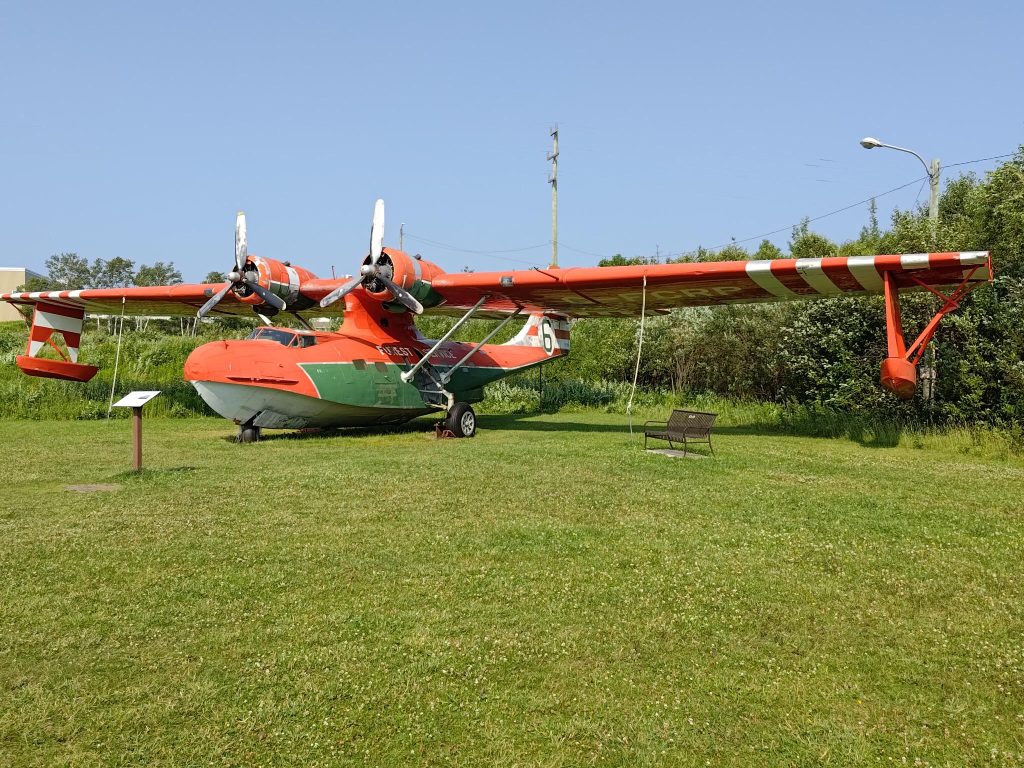
The museum had a Canso on display. It had been used in Newfoundland as a waterbomber fighting forest fires. These were Catalinas flying boats, which were modified with landing gear, transforming them into amphibians. The Catalina dates from 1933 when the US Navy ordered it, and Consolidated Aircraft designed it. A prototype was first flown in 1935 or 1936 (sources vary) in San Diego Bay. It became the most successful and prolific flying boat with 4 051 built. These aircraft were used in WWII by the American, British and Soviet Air Forces. Many of these aircraft came through Gander on their way across the Atlantic. Consolidated Aircraft and its successor Consolidated-Vultee Aircraft (Convair) built 1851 of these in San Diego, California. An undisclosed number were made by Vickers in Montreal starting in 1941-06. In addition, the Canadian government awarded Canadian Vickers a contract to produce PBV-1 Canso amphibians (a version of the Consolidated PBY Catalina flying boat) for the Royal Canadian Air Force. To speed Canso production, the government authorized construction of a new manufacturing facility at Cartierville Airport in Ville Saint Laurent, on the north-western outskirts of Montreal, and appointed Canadian Vickers to manage the plant’s operation; 240 PB2B-1 flying boats were made for the Royal Air Force (RAF) and RCAF patrol bomber squadrons, 55 PB2B-1A and 67 PB2B-2 planes were also built by Boeing Canada, at a facility located on Sea Island, in Richmond, British Columbia. The site has since been re-developed as the Burkeville residential area, named for former Boeing-Canada President Stanley Burke. The PBN-1 Nomad, a heavily modified Catalina, was built by the Naval Aircraft Factory in Philadelphia, Pennsylvania, supplying 155 to the RAF and 138 to the Soviet Navy. Soviet Gidrosamolet Transportnii factory at Taganrog, Rostov Oblast, also built 27 Catalinas.
In Scandinavia, the most prominent incident involving these planes was the Catalina Affair in which a Swedish Air Force search and rescue/maritime patrol Catalina = TP 47 was shot down by Soviet MiG 15 fighters over the Baltic Sea in 1952-06-16 while investigating the disappearance of a Swedish Douglas DC-3A-360 Skytrain Hugin on a signals intelligence mission, 1952-06-13, later found to have been shot down by Soviet MiG-15s in Swedish waters. The DC-3 was found in 2003 and raised in 2004–2005. In Norse mythology, Huginn = thought (Old Norse) and Muninn = memory (Old Norse) are a pair of ravens that fly all over Midgard = the world, and bring information to the god Odin.
In terms of aircraft, I have always been fascinated with amphibians, especially the Grumman Goose, possibly because it was featured in The Islanders, a 24 episode television series shown from 1960 to 1961, with William Reynolds (1931 – 2022) = Sandy Wade, James Philbrook (1924 – 1984) = Zack Mally, Diane Brewster (1931-1991) = Wilhelmina Vanderveer = Steamboat Willy and Roy Wright (? – ?) = Shipwreck Callighen, about a one-airplane airline run by the first three principals listed, in the East Indies.
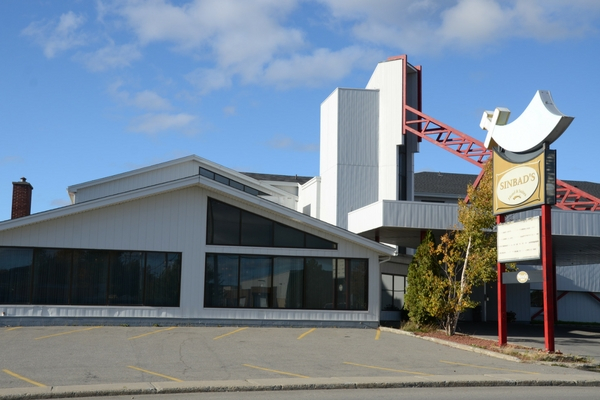
We stayed at another Steele hotel, Sinbad’s. In many ways it was the opposite of Glynmill Inn: a more modern design, a scimitar symbol, breakfast included. Inside, there was not much that exuded Arabia. I have always had a positive impression of Sinbad, the 8th century fictional mariner from Baghdad and the Abbasid Caliphate, who during seven voyages has fantastic adventures in magical realms. These became late additions to the Thousand and One Nights framing the fictional Persian king Shahryar, and the tales narrated by his wife Scheherazade.
Sinbad’s hotel in Gander, with its sign featuring a scimitar. Photo: Steele Hotels.
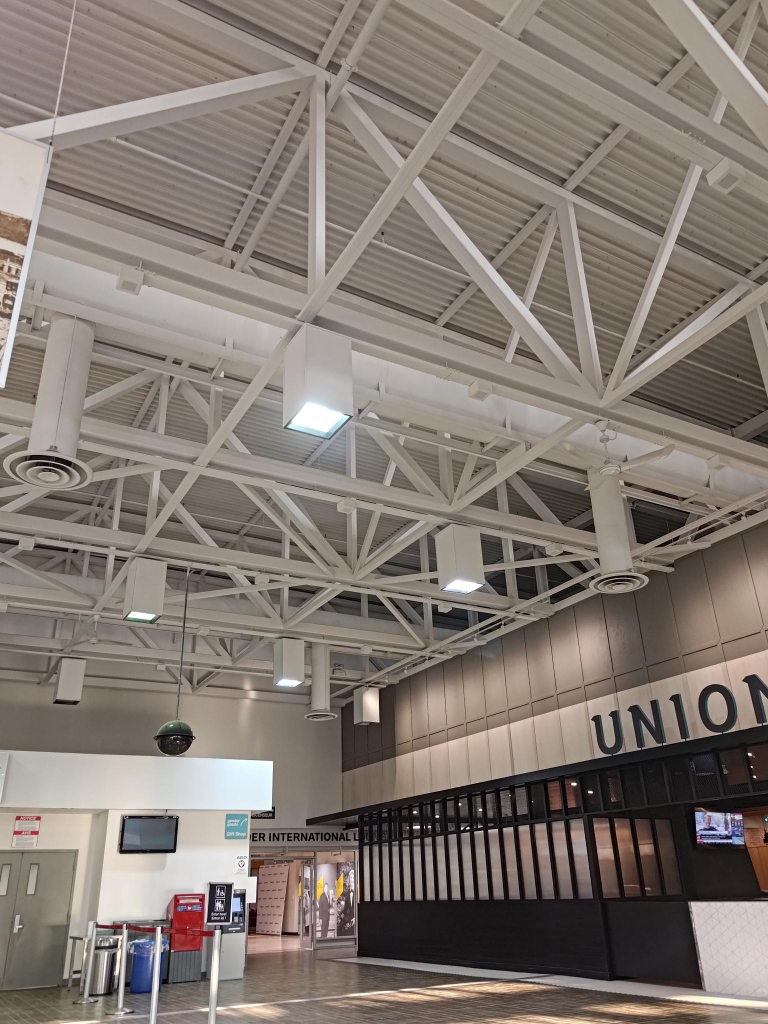
In the early evening we visited Gander airport. Above the main floor there was a display, showing its history.
The International Lounge was opened in 1959. It was given a CAD 1.5 million restoration, that was completed in the summer of 2020. Photo: Gander Airport.Welcome to CYQX Gander. Yes, the International Civil Aviation Organization (ICAO) uses CYQX for Gander. The International Air Transport Association (IATA) uses YQX.
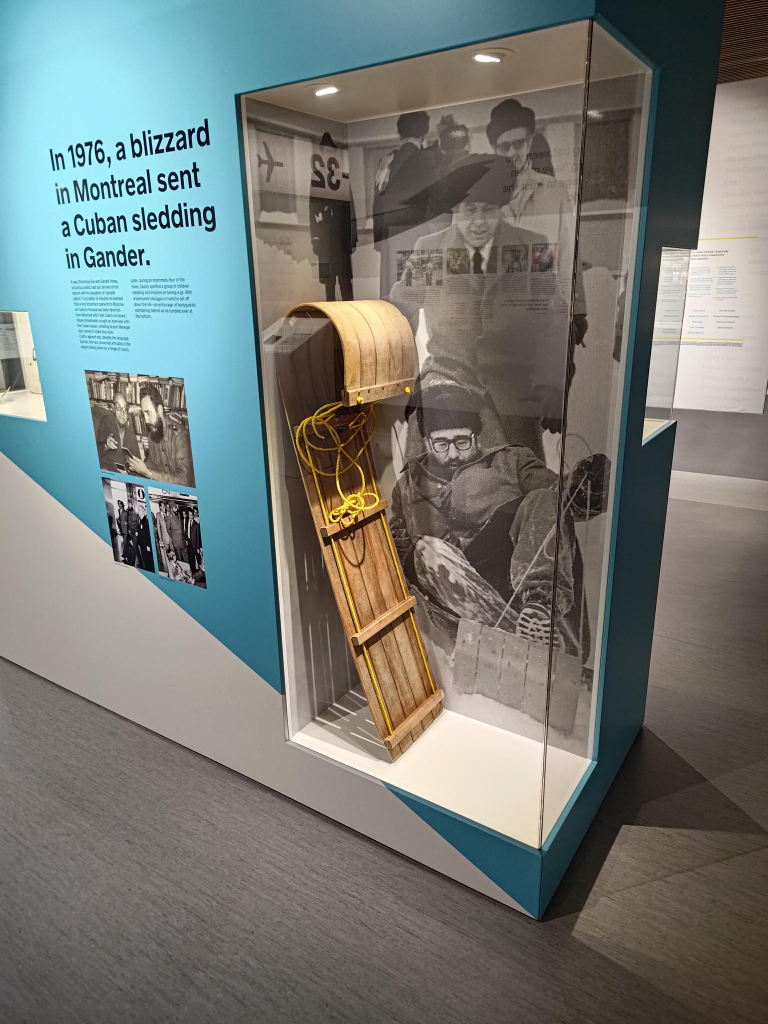
The exhibits included a toboggan, and a story of Fidel Castro tobogganing in Gander.
A toboggan, and a photo of Fidel Castro on a toboggan in 1976.Admittedly, I am a product of the 1950s, more turquoise than avocado green so prominent in the 1960s. Yes, colours should be bold, not timid.Support details
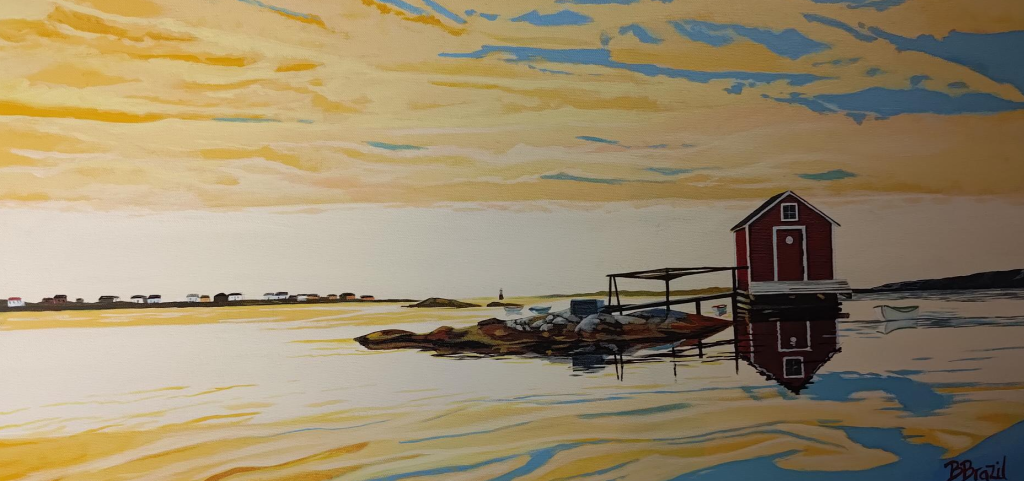
At the airport there was a display of paintings by Barbara Brazil. This one, titled Fair Isle, Fogo attracted our attention. Yes, I am always fascinated by how light influences perception.
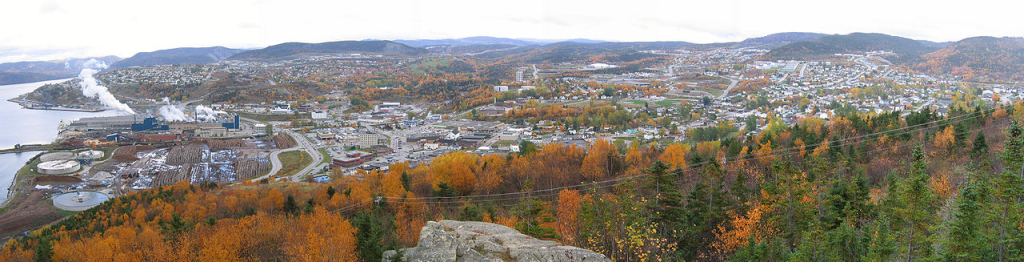
Corner Brook from James Cook park. Photograph: H. Keats, 2005-10-18.
In terms of our family history, Corner Brook was a regular port of call for my father-in-law Paddy (1911 – 1989) in the 1930s. He was an engineer on a freighter that was taking paper somewhere, possibly New York. He was also taking bananas somewhere else. Yes, it was a pity that someone did not listen carefully enough to record the details of these actions, although additional research could possibly find more facts.
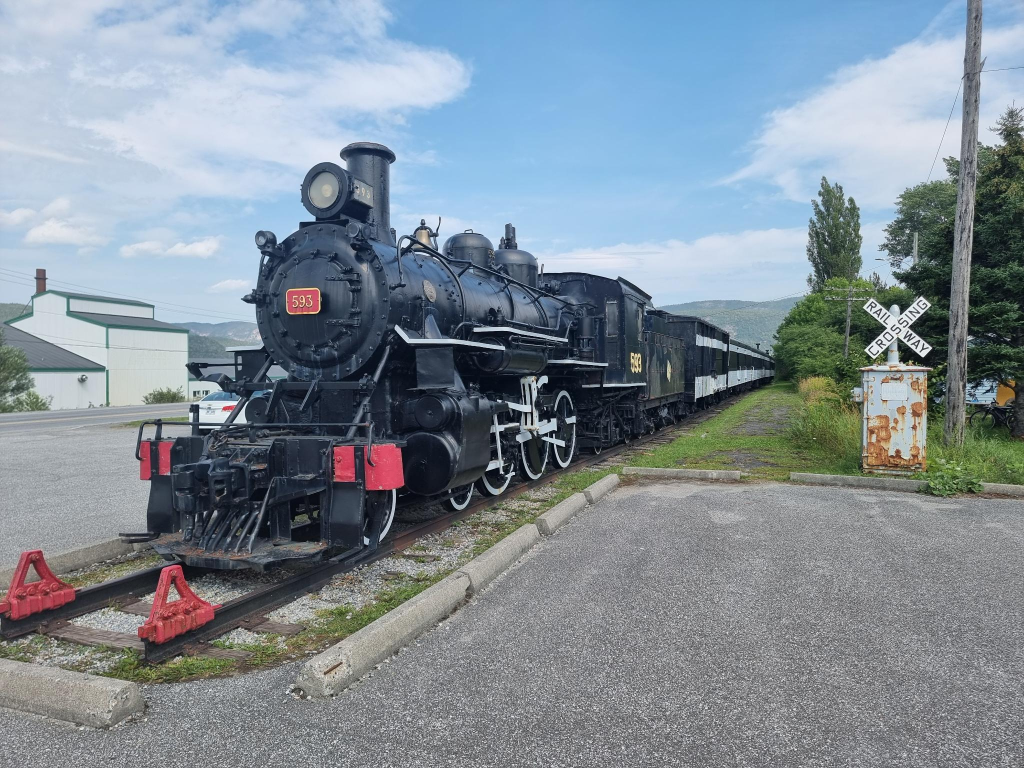
The distance between Genevieve Bay and Corner Brook is about 340 km, which takes about 4 hours (plus stops) to drive. While one could call the scenery attractive, it is also repetitive. There is not much variation to see along the route. Before officially arriving at Corner Brook, we paused at the Humbermouth railway station, home of Newfoundland railways locomotive 593. It was built at the Baldwin works in Philadelphia, and entered service in 1921. It retired in 1957.
The rail museum is yet another Newfoundland museum that has not entered the modern age. They expect people to pay entry fees (and everything else) in cash, which is something I refuse to do.
Corner Brook was a small community on the Humber Arm of the Bay of Islands in Western Newfoundland. A pulp and paper mill put Corner Brook on the map. Construction started in 1923 and it was completed in 1925. New Westminster, where I come from, also has a paper mill, without pulp production dating from 1922. Both are now owned by Kruger.
Sawmilling had been an important activity in the Bay of Islands starting in the 1860’s. The Newfoundland railway provided a reliable transportation link with the rest of Newfoundland, starting in 1888. The area, and Newfoundland more generally, held vast expanses of forests. These were useful to fuel the growth of newspapers in Europe and North America. The mill was a major economic benefit pumping millions of dollars into the economy, encouraging the development of new skills, increasing employment, generated new services and stimulating building construction.
Perhaps the most negative impact of pulp production was their sulpher smell. That said, there was no unpleasant odor in Corner Brook.
For me, Corner Brook was a relaxing town, admittedly with some traffic challenges. I am sure the locals have no trouble navigating its urban idiosyncrasies, but the streets have unexpected curves.
I enjoyed the diner where we chose to eat. Basic food, which is what I prefer.
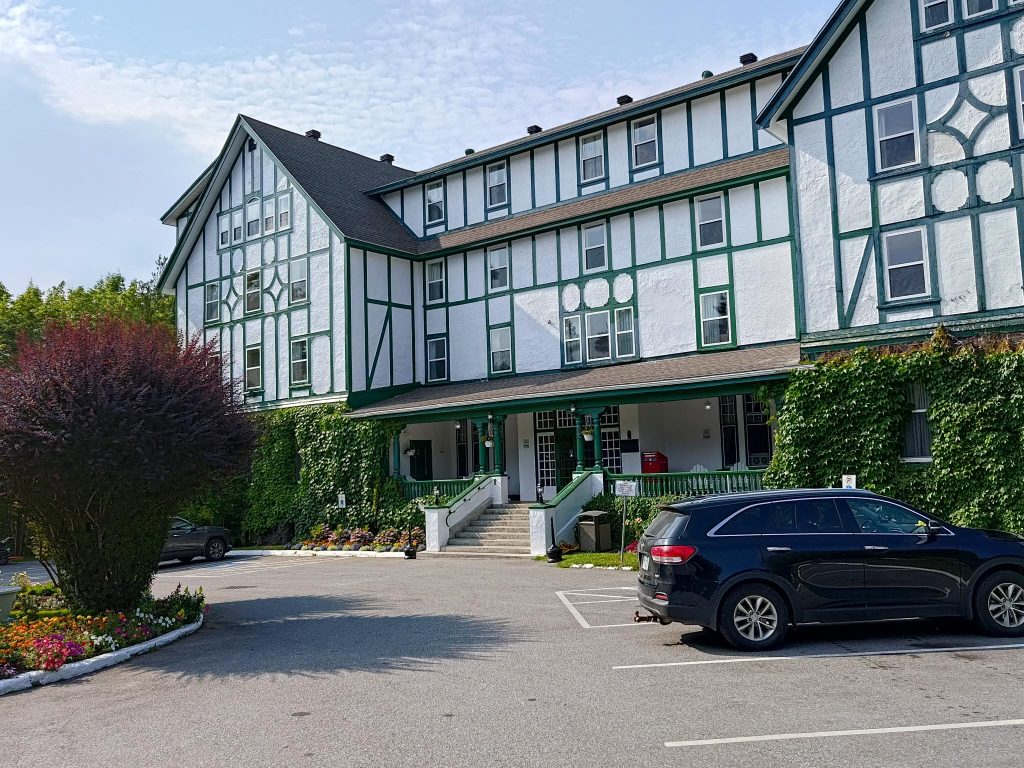
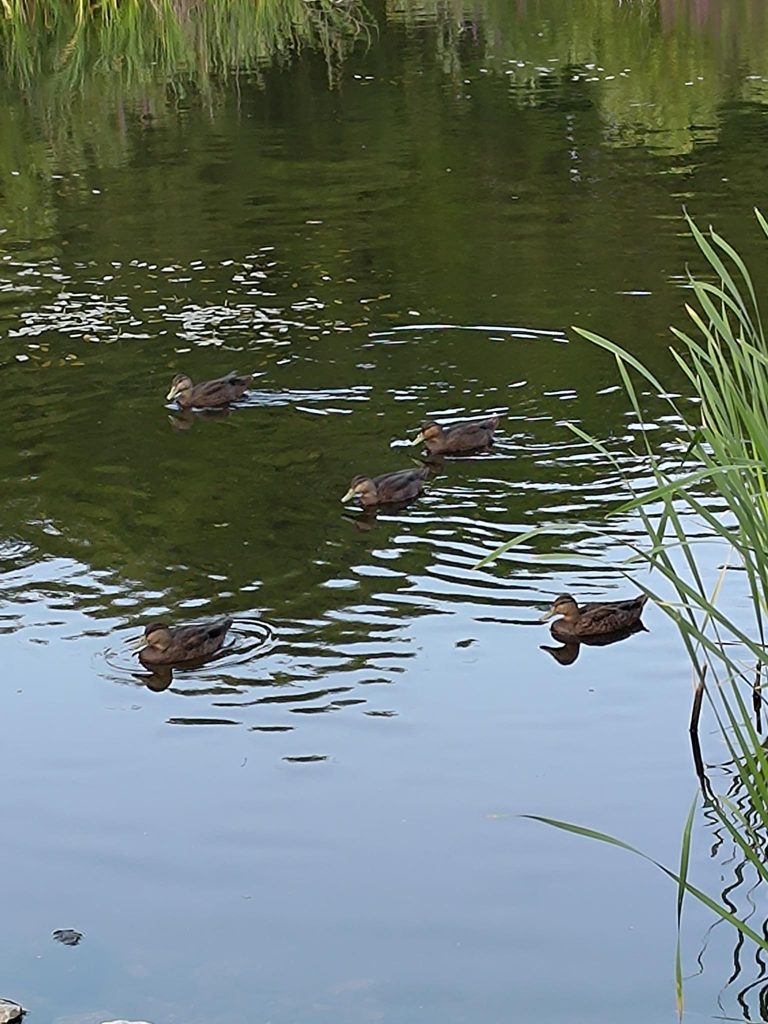
We stayed at the Glynmill Inn, a registered heritage structure in Tudor revival style, with 78 guest rooms. It was designed and built in 1923 by Nova Scotia architect Andrew Cobb (1876 – 1943) to house employees and senior staff during the construction of the paper mill. It was converted into a hotel in 1925. It is adjacent to Glynmill pond, which provided an opportunity to become acquainted with the local wildlife.
As I write this post, I am listening to Bay (of Islands) FM at 100.1. It is 07:00 in Corner Brook, but already 11:30 here in Norway. It’s studio is located at the Inn.
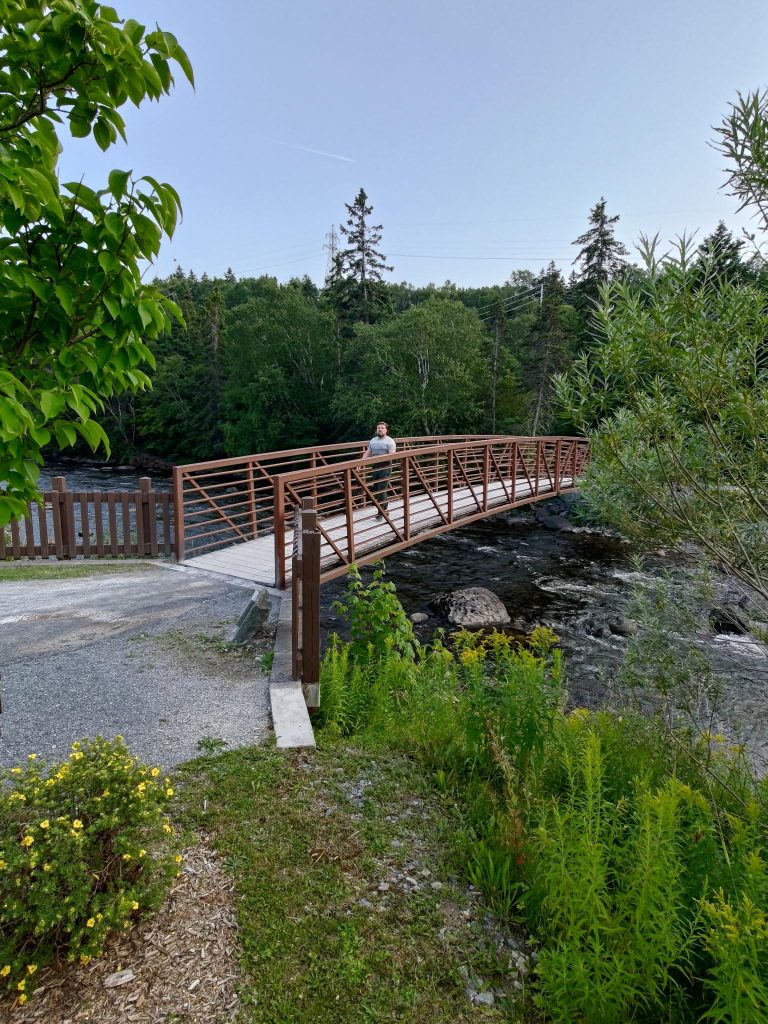
Alasdair crossing the bridge at the western end of the Corner Brook Stream trail.Residents of Glynmill pond.
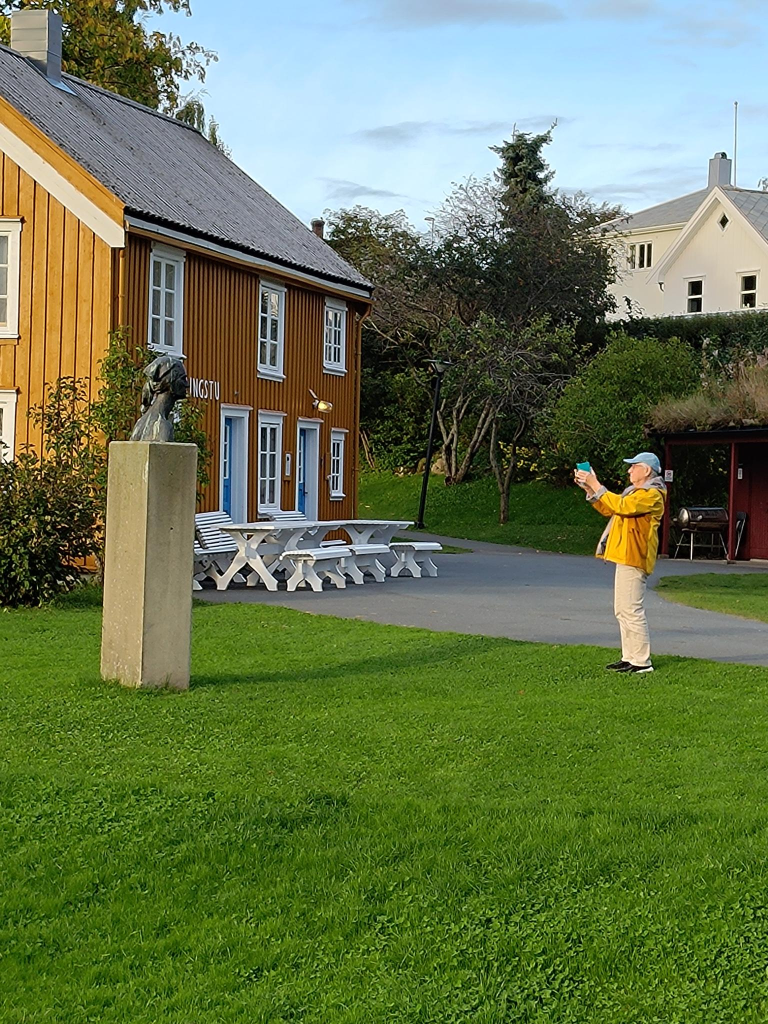
Sometimes my competitive spirit shows itself. Such was the case on Friday, 2024-09-20. Trish suggested that we go for a walk, then do our weekly grocery shopping. For once, I managed to suggest a place to walk that was acceptable to her: the sculpture trail in Straumen, mostly featuring the works of Nils Aas (1933 – 2004). Muustrøparken = the sculpture park, is named after Lorents D. Muus (1809–87). As Norwegians euphemistically say, Muus wore many different hats throughout his life. He was a merchant, banker, post office official and mayor.
On arrival, Trish began taking photos that told me she had decided to write a weblog post about it. When she admitted to me that she had taken a photo of the map in the park, I knew how that post would appear. Yes, it is amazing what one can imagine after knowing someone for just fifty years. That map would be at the top, followed by up to 20 photos of the artwork. Not so many words because, as everyone knows, each photo eliminates the need for 1 000 words. The works in the Nils Aas gallery and workshop would not be included, but some of the park environment (including buildings and the creek, natives call Granelva = the Gran river) would be.
… and so we return to that competitive spirit. Most of the photographs I took were found objects in the park. Some even had sculptural shapes.
Back at Cliff Cottage, I had begun to assemble these into a weblog post of my own. Then I thought it would be a good idea to check my emails, yet again. A column alert from Gloria, two replies from Art, then disaster …
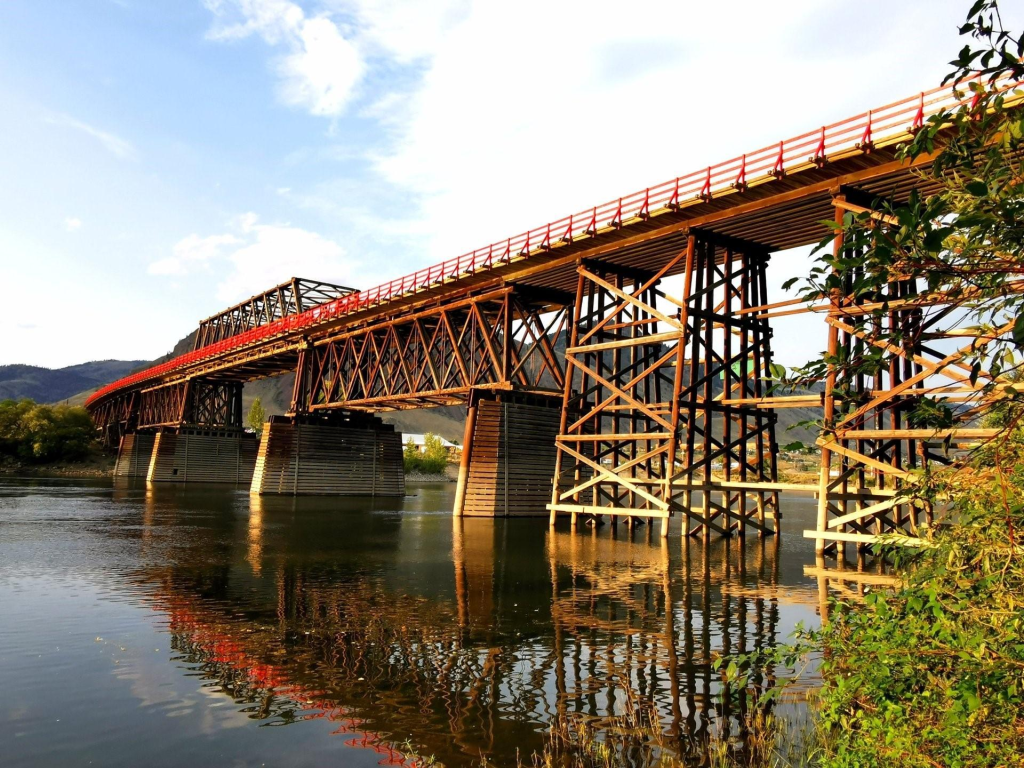
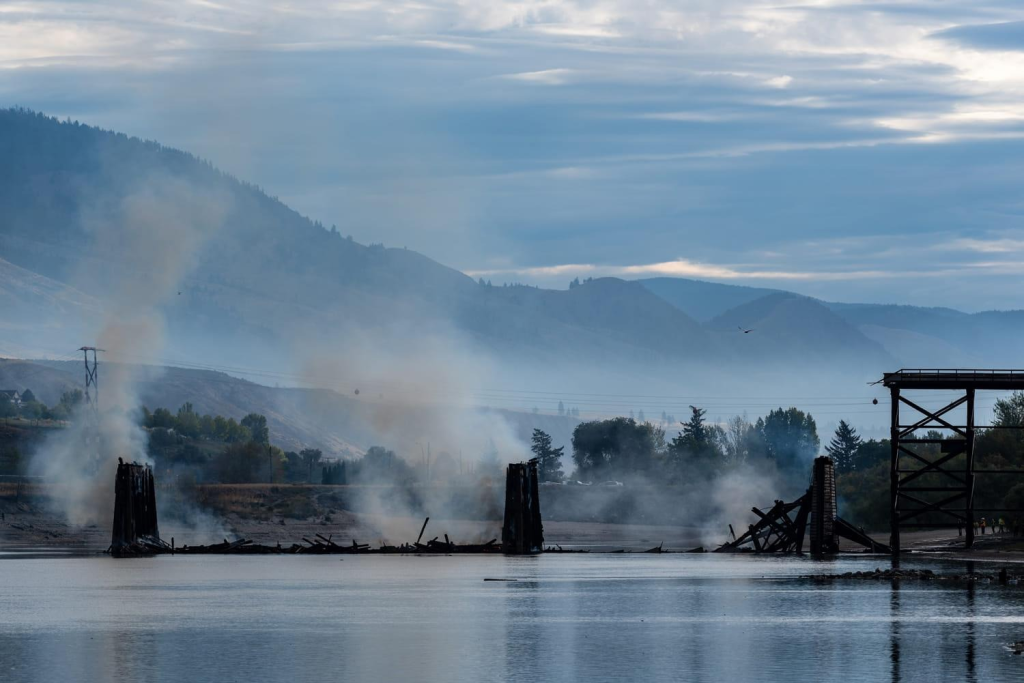
Trish had been using Chat on G-mail to communicate with her sister, Aileen. A message came in: The Red Bridge in Kamloops has burnt down. (timestamp 20:42). I know the bridge well, since my childhood. In the summer there were always children diving off it. On Signal, I posted a photo of it in happier days (timestamp 20:45). This was followed by a photo sent by Trish of its smoldering remains (timestamp 20:47). The red bridge exists no more. There was a fire on 2024-09-17 that was put out. Then on 2024-09-19 a different fire roared to life. Arson is suspected.
… and so unexpected events deflect the focus of one’s life. The bridge was built in 1936, so anyone remembering that location before the bridge, will probably have to be 93 or older to have it persist in their memory. Yes, there were two other bridges at the same location. The first from 1887, was flood damaged in 1909, and replaced in 1912. That second bridge was destroyed by fire caused by a spark from a passing steamer in 1934.
There was one photo I did not take in the park. I thought of taking it, but didn’t because I knew it would still be there the next time I visited. With the bridge fire in Kamloops, there is some urgency to take it now. I know where this photo will be used: Shrinking the Garage, a weblog post currently scheduled for publication 2025-10-29. It is more than a year away, and so I have time. One always has time, until one doesn’t.
An eager photographer in action, taking photographs of legitimate artwork.A potential sculpture hiding in the bushes. One of the park’s many wide eyed beggars, asking anyone passing by for a handout.Not everything in the park is a work of art, but many plants have aesthetic values.A camouflaged micro-hydro-electric-turbine that should be producing electricity, but isn’t!The park is a place for friends of different heights to meet, ranging from a shy, but tall pole vaulter, in the top left of the photo, to a short manhole (personhole) cover, in the foreground.Muusbrua = The Muus Bridge was built in 1816.
The visit to the Viking site at L’Anse aux Meadows, was a highlight of our trip to Newfoundland. Our guide, local resident Kayla, was educated as a folklorist, which means she was trained to tell stories. These were informative. We certainly gained a better understanding of the Viking settlement there. Lots of talk about the use of bog iron to make iron. In a reconstructed viking house, we also met a freeman who was doing wood working, and a freewoman who was weaving. Both of them should be happy that they did not need to rely on their crafts to support themselves!
There is a Norwegian connection that begins with Helge Ingstad. He is one of few people who have lived in three different centuries. He was born in 1899-12-30 in Meråker and died 2001-03-29 in Oslo. Meråker is in Trøndelag county where we live, but perhaps 100 km further south, and adjacent to Sweden. Helge was educated as a lawyer, and had a practice in Levanger, about 50 km further south from Cliff Cottage. In 1926 he explored the wilderness of Canada, working at times as a fur trader, before becoming the Governor of Norwegian territories on Greenland, then Svalbard = Spitsbergen.
In Svalbard he met Anne Stine Moe (1918-1997). They married in 1941. In 1946, they moved to the Holmenkollen area of Oslo, where they lived when not travelling the world. Anne Stine was an archaeologist. The couple also began to go through saga texts and archaeological material from the northern regions, where they came across a hypothesis put forward by the Swedish philologist Sven Söderberg (1928 – 2004), that the prefix -vín in Vinland did not necessarily have to do with wine, but rather with the old Norse language vín in the sense of meadow, field, grassland, as in the old name for Bergen, Bjørgvin.
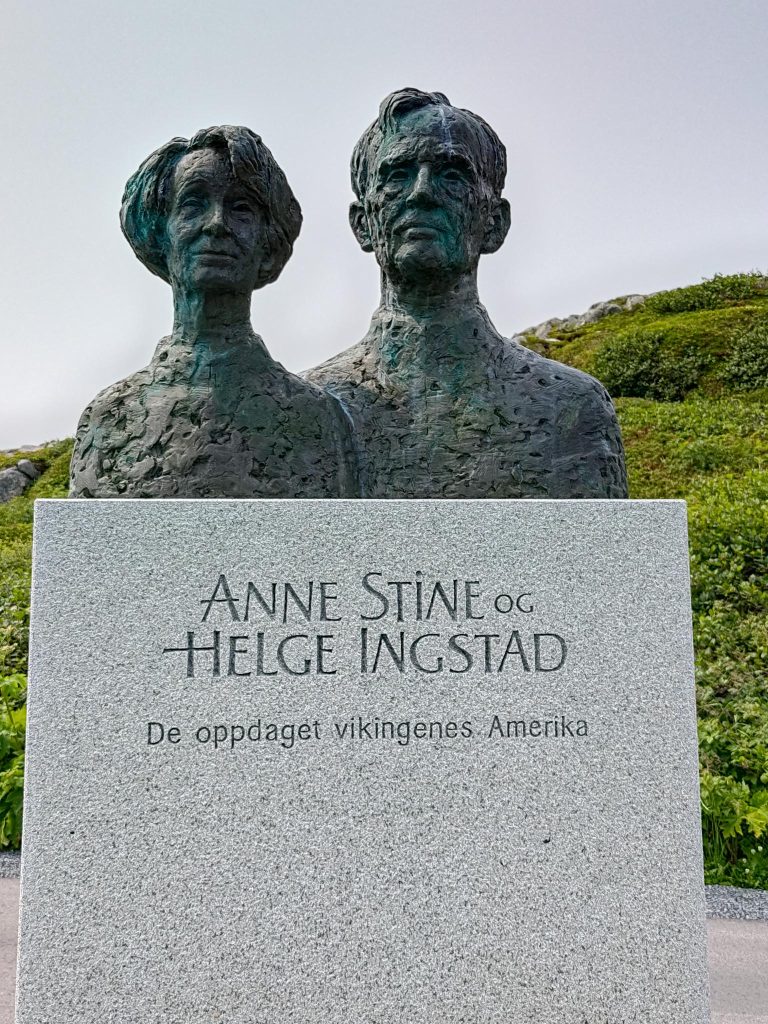
“Anne Stine and Helge Ingstad, they discovered the Viking’s America.” This is the inscription in Norwegian on the support for their busts at the entrance of L’Anse aux Meadows visitor centre. It was made by Inderøy sculptor Nils Aas, and given from Norway to Canada in 2001, after Helge Ingstad’s death.
Between 1961 and 1968, the Ingstads discovered settlement traces at L’Anse aux Meadows, that turned out to be Nordic from the Viking period. Folklorist Kayla thought that the reason why the Ingstads managed to discover them had to do with Helge’s personality. People did not view him as an aloof academic or professional, but an ordinary person local residents could relate to. He established rapport with the people he spoke to, before asking questions. This meant he received honest replies. His questions often had to do with humps and bumps in the local landscape that could conceal an archaeological site! When he asked local resident George Decker that question, he was shown L’Anse aux Meadows!
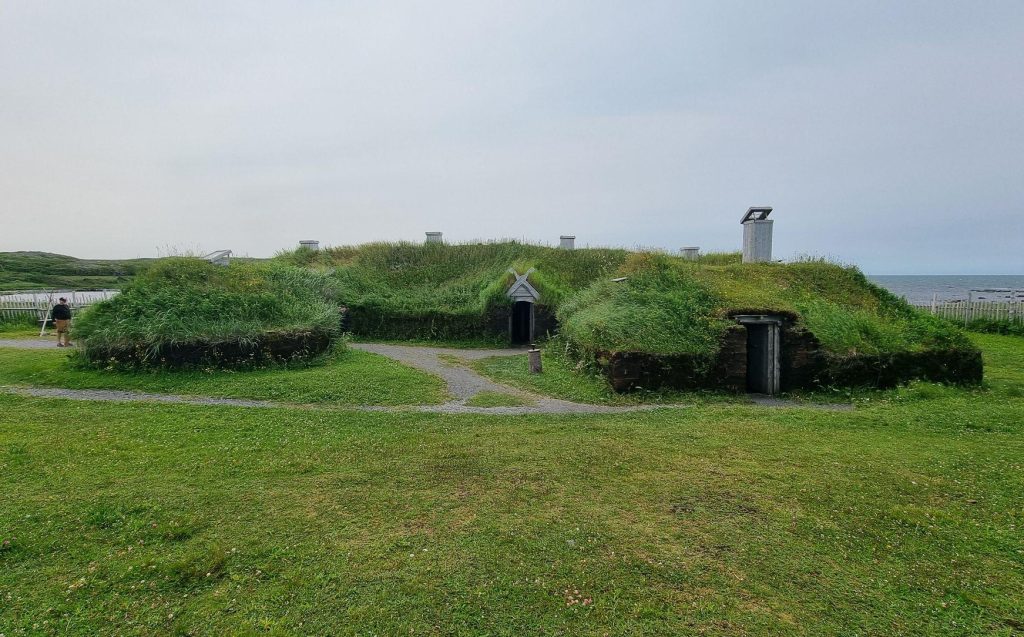
The outside of a reconstructed Viking longhouse at L’Anse aux Meadows. No, the Vikings did not use chimneys, but modern fire regulations require them. Photo: Alasdair McLellan.The inside of a reconstructed Viking Longhouse at L’Anse aux Meadows. Photo: Alasdair McLellan.
L’Anse aux Meadows was not located in Vinland. That was further south, possibly in New Brunswick. L’Anse aux Meadows was a boat repair centre, sometimes referred to as a pit stop, used seasonally. After about one generation of use, valuable possessions were removed from the settlement, and what remained was deliberately destroyed.
“Anne Stine and Helge Ingstad, they discovered the Viking’s America.” This is the Norwegian inscription on the sculpture at the entrance of L’Anse aux Meadows visitor centre, made by Inderøy sculptor Nils Aas, who was raised in Straumen, 13 km from Cliff Cottage. The sculpture was given by the people of Norway to the people of Canada in 2001, mediated by the Norwegian king Harald, after Helge Ingstad’s death.
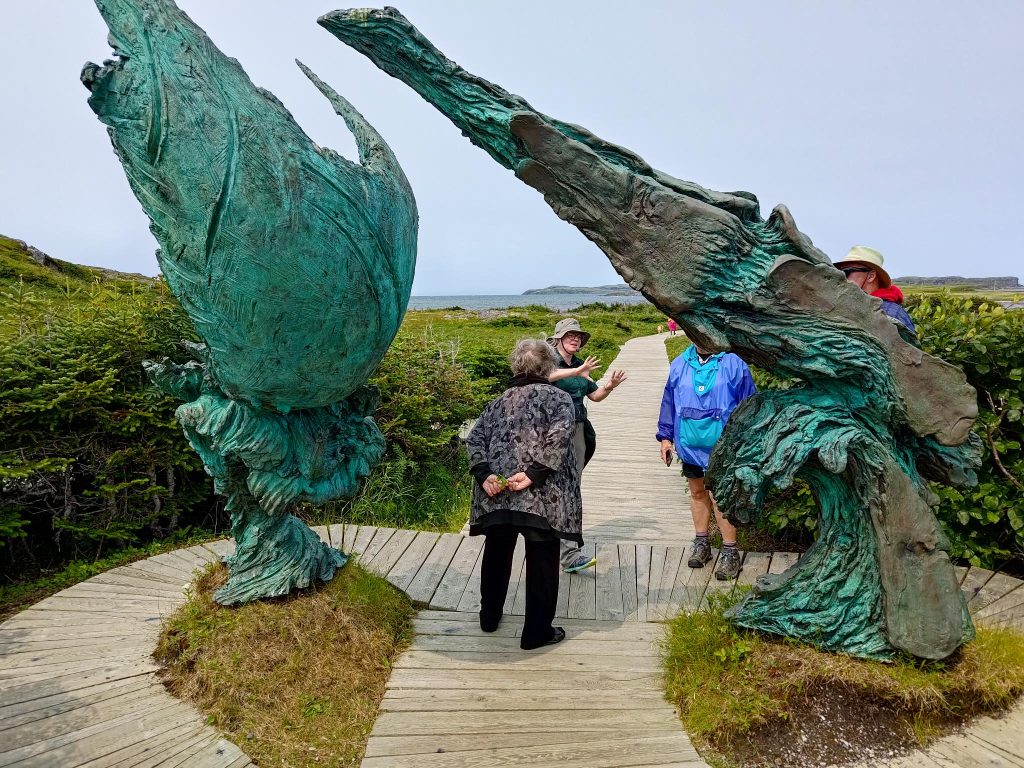
Sandra (1943 – ), one of the visitors, was having some difficulty walking, so I slowly walked with her through the site, while the young people walked quickly on, but had to wait for us to catch up. Little at the site is a thousand years old. Luben Boykov (1960 – ) and Richard Brixel (1943 – 2019) created each their half of The Meeting of Two Worlds, unveiled 2002-07-06. The sculpture symbolizes the suspected meeting of the Norse and the Indigenous peoples of North America
Sandra (1943 – ) with her back to the camera, and other, half hidden visitors, listening to the guide Kayla, at The Meeting of Two Worlds sculpture.
YAY
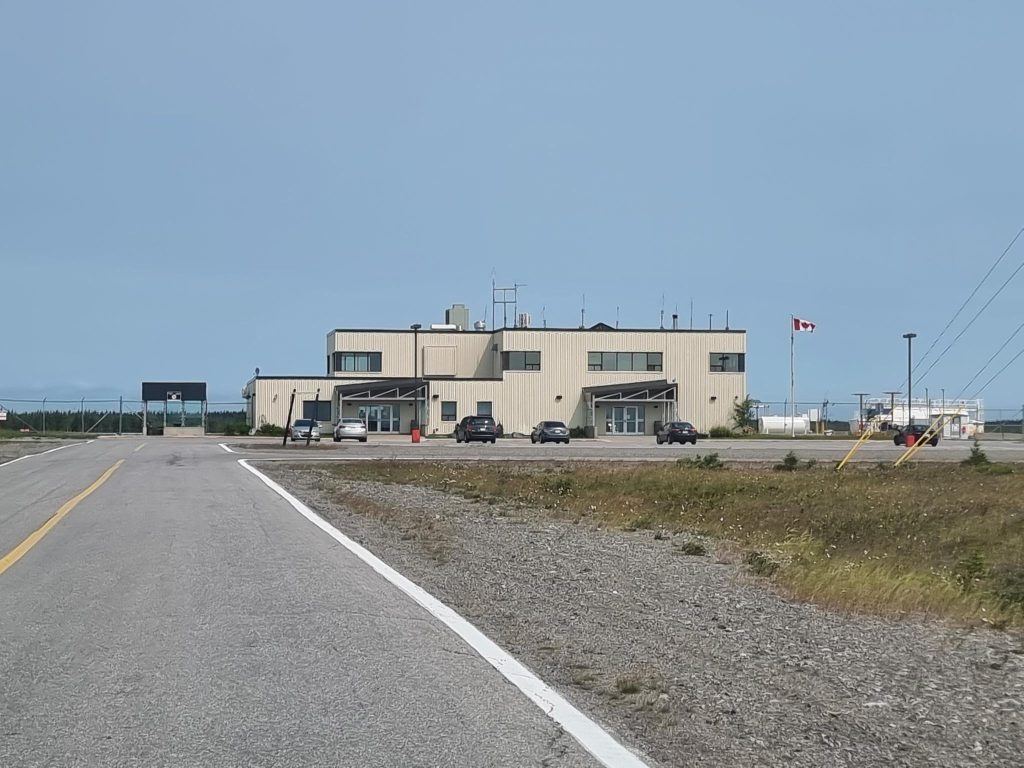
Of course we visit airports when given an opportunity. On the Great Northern Peninsula, YAY airport is located at St. Anthony. We visited it on our way to L’Anse aux Meadows. There are about eight scheduled flights a week: five involve YXB at Blanc-Sablon, Quebec; three YYT at St. John’s.
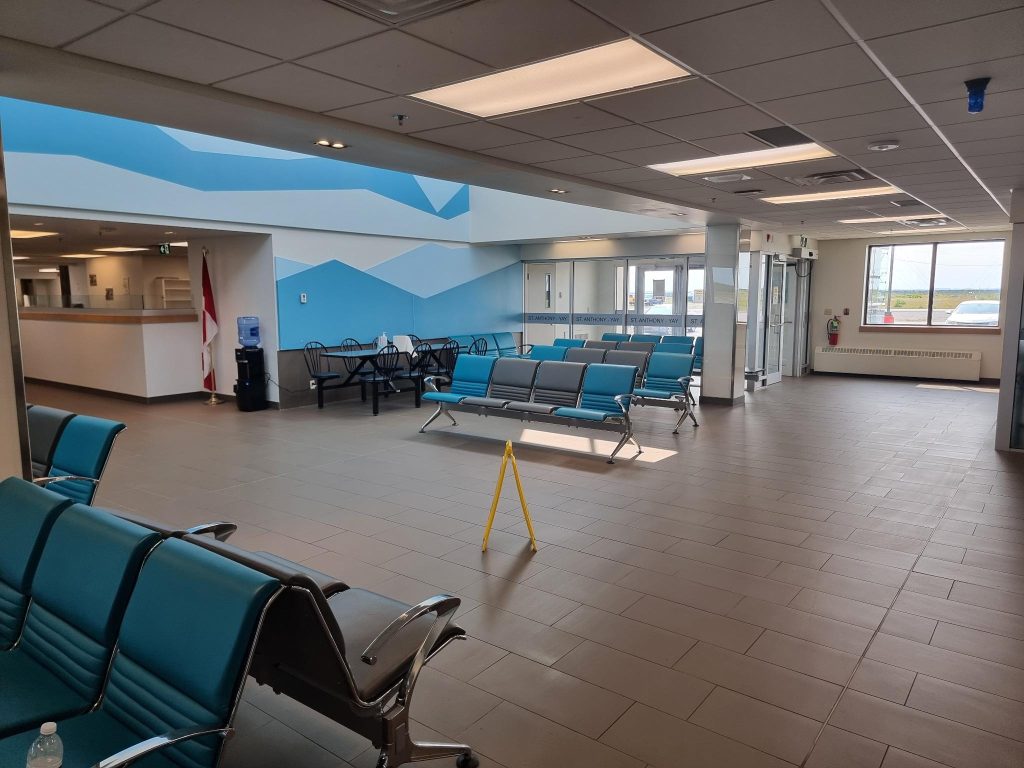
After entering the airport, we (as in Alasdair) were able to take a lot of photographs without having to disturb or be disturbed by passengers. The security guard was unperturbed by our presence.
The exterior of the YAY airport at St. Anthony, Newfoundland. Photo: Alasdair McLellanThe transit hall of YAY airport at St. Anthony. We were advised by a sign that the floor could be slippy. Photo: Alasdair McLellan.
Meanwhile back at the Genevieve Bay Inn
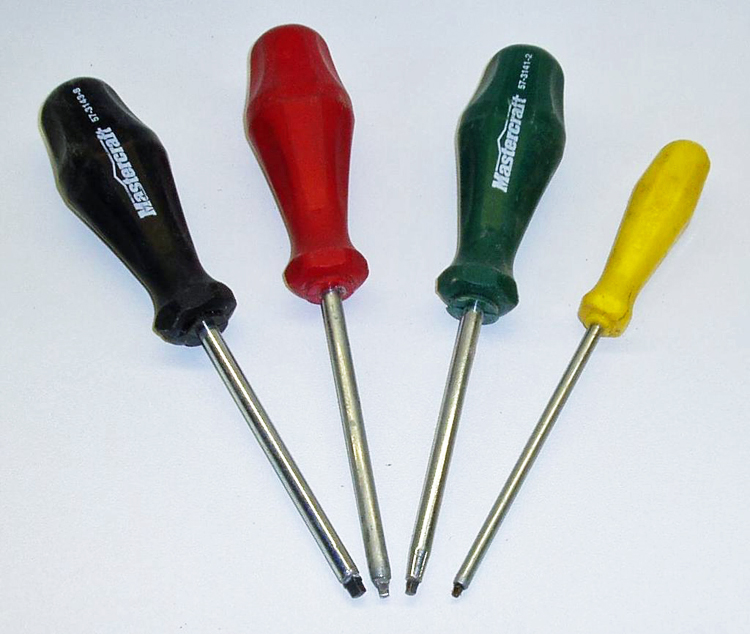
I talked to Wilfred Doyle, who – with his wife Donna – owns the Genevieve Bay Inn where we stayed. Wilfred’s area of responsibility is maintenance, as well as Thirsty’s Lounge = the largest bar in Newfoundland, opened 2003-12-31. Donna seems to be in charge of everything else. At the inn, most rooms are fitted with two home-made double bunk beds, to accommodate eight. These are family rooms. Not everyone is expected to share a bed with someone. I complimented Wilfred on the use of Robertson screws in the beds he made. He admitted, he prefers to use Robertson, but will use Torx if there is nothing else.
Four Robertson screwdrivers, known for their sloping/ inclined square bits: black (#3), red (#2), green (#1) and yellow (#0), Orange (#00) and brown (#4) screwdrivers are also available, but are not in common use. Photo: Luigi Zanasi, 2005-10-16.
One of the guests had hit a Moose on the highway with his smallish Toyota. All the passengers (including his two younger children) had survived without injury. We talked about this, snow, studded snow tires and moose hunting.
I am not overly enthusiastic about Toyota cars, but was impressed with the condition of this one, after it had encountered a moose travelling at highway speeds in Newfoundland. In Newfoundland, license plates are only fitted to the rear of a vehicle.
Wilfred says that there is less snow now than previously, so he changes his “tires and rims” close to the end of November, then back again, some time in April. He is an active moose hunter. Which means he watches the moose from inside the Inn. When one is coming through, he gets his rifle, goes outside and shoots it. This is not hunting for sport, but food, possibly the difference between survival and starvation, a century before.
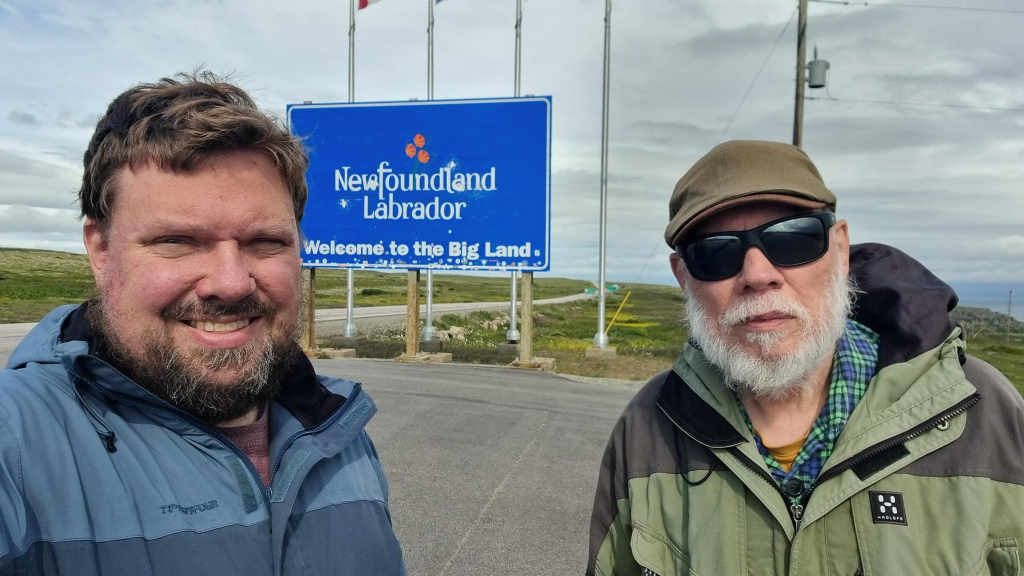
A selfie taken at the border between Quebec (to the left) and Labrador (to the right). Photo: Alasdair McLellan.
As a naturalized Norwegian, one acquires a number of skills that people of other nationalities can only dream about. In today’s weblog post, the focus is a detailed insight into ferry operations. Perhaps I should start by bragging about living 300 meters from a ferry terminal, although that ferry was replaced by a bridge on 1991-12-19.
This is mentioned because our visit to Red Bay in Labrador, required the use of a ferry across the Strait of Belle Isle. The route is between terminals at St. Barbe on Newfoundland’s Great Northern Peninsula and Blanc-Sablon in Quebec. Theoretically, the crossing takes 1 hour 45 minutes, and covers 36 km. The first problem is that one has to meet up one hour ahead of the scheduled departure time, if one has a reservation. The second is that the ferry was not ready to leave at its scheduled departure time.
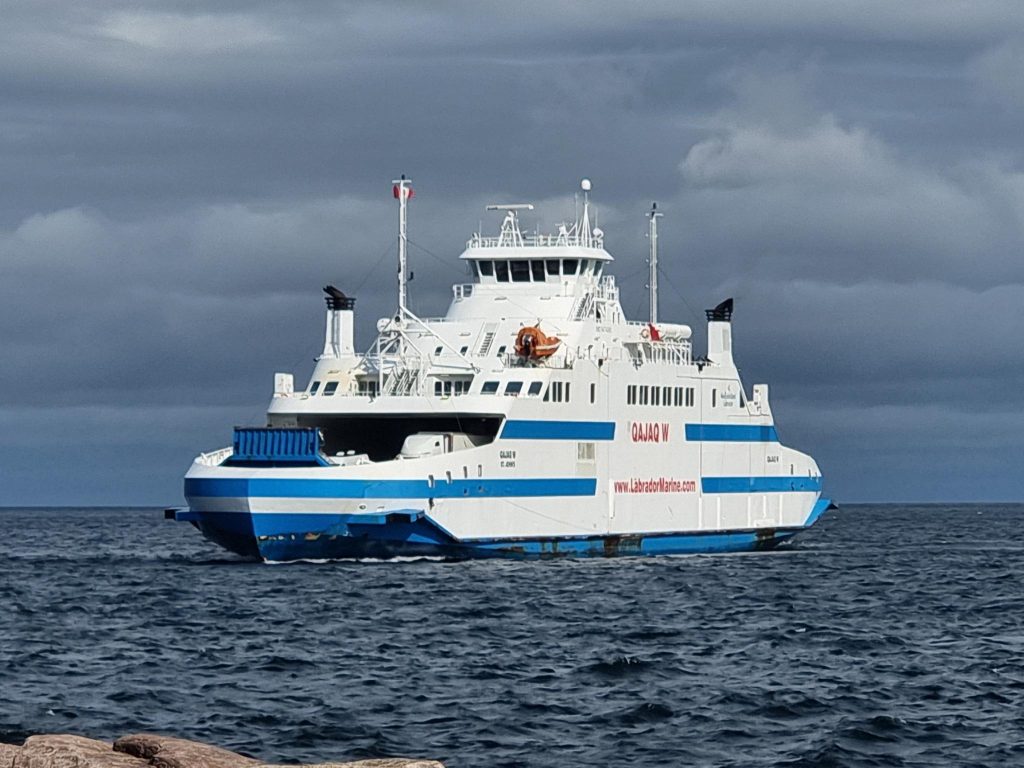
MV Qajaq W (the middle part is pronounced kayak) has been used on the route since 2019. It can carry 120 standard vehicles, including up to 8 tractor trailers, along with 300 passengers.
The MV Qajaq W
Qajaq was built in 2010, it has a length of 97.84 m, and has 5 233 gross tonnage. Working backwards from 5.6 MW of power, it is likely that it is equipped with 4 Wärtsilä BL20 engines, each providing 1 400 kW. It has an ice classification 1A, which is immediately below the best joint Finnish-Swedish ice-classification for merchant ships, 1A Super. Both bows are ice-strengthened. It was built in Norway at Fiskerstrand, outside of Ålesund, As MV Muhumaa, it sailed in the Baltic between Saaremaa island in Estonia and Ventspils in Latvia from 2011 to 2017.
This vessel replaced the 108.7 m long MV Apollo completed in 1970, that was unsuitable for the route, despite it being a Baltic ferry. The Apollo was equipped with accommodation for 1 500 people, that was never used. The Apollo had 2 x 3 400 kW MAN 9L32/36 diesel engines (altogether 6.8 MW), and 6 609 gross tonnage. At times, ice prevented it from landing at St. Barbe, and it would be redirected to Corner Brook, taking 12 hours for the crossing from Labrador. It was taken out of service in 2019, and scrapped in Turkey, in 2021.
Most Norwegian ferries simply drive into the dock (at low speed), and use their engines/ motors to keep their position as vehicles and passenger leave and enter. An even more advanced Auto-docking eliminating human input, has been a reality on some routes since 2018. Electric ferries have been used since 2015, and complete electrification is expected in 2025.
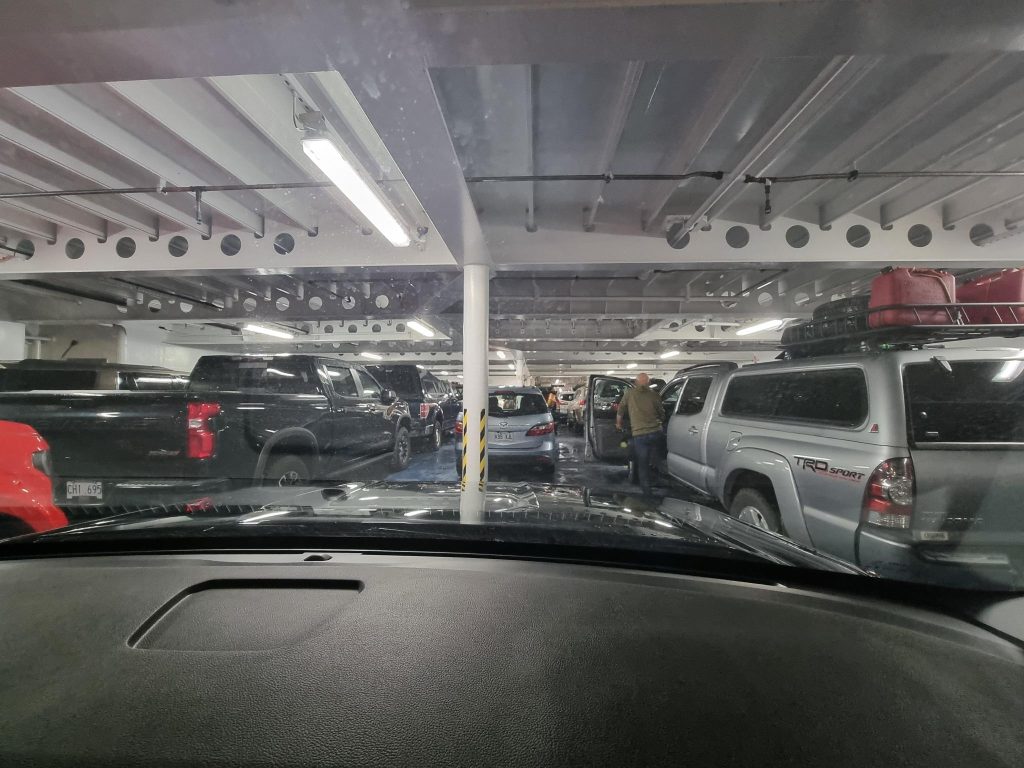
The interior of the MV Qajaq W, showing the middle lane of the lower car deck. Hélène’s Mazda 5 is immediately in front of ours. Photo: Alasdair McLellan
The ferry left about half-an hour late, mainly due to a design feature where, after service in the Baltic, the number of lanes of vehicles onboard the lower car deck was reduced from six to five, because north Americans prefer larger vehicles. With the middle lane being underused, because the crew spent precious loading minutes parking vehicles between support columns. We were shunted into this middle lane. Immediately ahead of us was a Mazda 5, identical to Alasdair’s. On my way to the passenger deck, I complemented the woman owner, Hélène, on her very attractive vehicle.
As for the ferry, my advice would be to just use four lanes, in an attempt to speed up loading, and in doing so, be able to make an extra trip each way, each day. I also note that some days there are an odd number of trips made, meaning that the ferry overnights on a different side of the strait.
After landing in Quebec, it did not take us many minutes to drive the 6 km to the Labrador border. We continued onwards to the tourist office, to make important enquiries, such as finding places to buy a Labrador flag.
The Labrador Flag as specified, and originally made in 1973-4.
The Labrador flag was the most popular flag in Newfoundland. Yes, much more popular than the Canadian or Newfoundland flags. It was created in 1973 by a small group of Labradorians led by Michael S. Martin (1938 – ), then representative for Labrador South in the provincial legislature, to celebrate the then upcoming 25th anniversary of Newfoundland and Labrador’s entry into Canadian confederation, Many regard the creation of the Labrador flag as an act of political mischief/ vexation aimed at Premier Joey Smallwood (1909 – 1990) and his Liberal government’s perceived indifference to Labrador.
Patricia (Bryne) Martin sewed 64 flags, while her husband used a marker pen to add a spruce twig to each: 59 of the flags were given to Labrador communities, 3 to Labrador representatives in the provincial House of Representatives, One was for her husband, and another for herself.
The flag can be regarded as being 10:5 = 2:1 in proportions, with three fesses = wide horizontal bands, in flagspeak. From the top they are white, green (Pantone Green 356) and blue (Pantone Blue 306), in a proportion of 2:1:2. On the left of the white field is a stylized representation of a black spruce sprig, which is the most common tree, not just in Labrador but also in Newfoundland. Its is intended to remind viewers that Labrador is part of that province.
The flag’s colours are mirrored in the flag of Nunatsiavut = the Labrador Inuit Association. The black spruce twig was adopted for use on the Franco-Terreneuvien = French Newfoundlander flag.
Any six-year old, following a flag description, should be able to draw and colour any flag. If s/ he can’t, then the flag is too complex. We ended up buying both a Quebec and Labrador flag. Most Labrador flags (including ours) are fake/ bootleg. Michael Martin commented, “The problem stems from efforts by unscrupulous dealers and manufacturers to get around the copyright requirements by creating flags that have the wrong dimensions, wrong colours and wrong shape and size of the black spruce twig.” This is a common problem when attempting to buy flags! Justin Brake wrote about this situation ten year ago! The Labrador flag is now over 50 years old.
Red Bay
About 80 km north of Blanc-Sablon is the former whaling station at Red Bay. Starting in 1530 and lasting for almost 100 years, it was a major Basque whaling area. Several whaling ships, both large galleons and small chalupas, sank there. Their discovery led to the designation of Red Bay in 2013 as a UNESCO World Heritage Site. Data from the 2021 census shows that Red Bay had a population of 142 living in 65 of its 69 total private dwellings. That is down 16% from its 2016 population of 169. It’s land area is 2.31 km2.
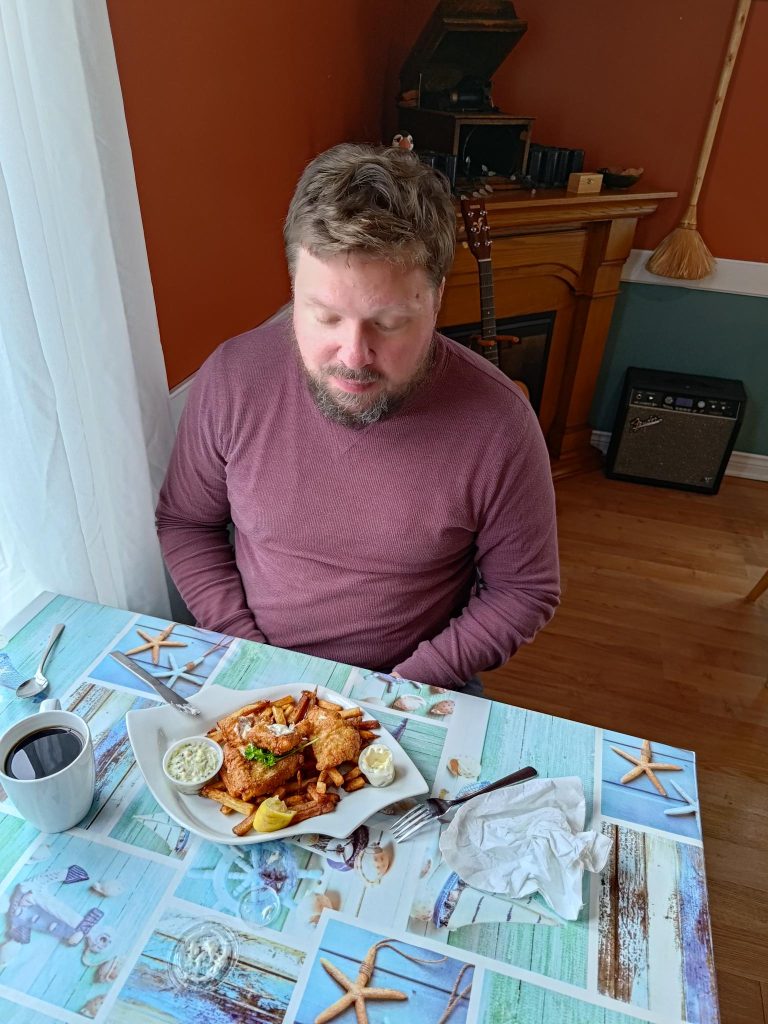
A bus load of tourists, travelling on our ferry, arrived at about the same time as us. They managed to inundate the local museum, so Alasdair and I thought the best counter move was to visit the Whaler’s Restaurant. When I asked for a meal of whale meat, I was politely told that they were sold out. Both Alasdair and I ate their fish and chips.
Coffee with Fish and Chips, but not many vegetables
Return to Newfoundland
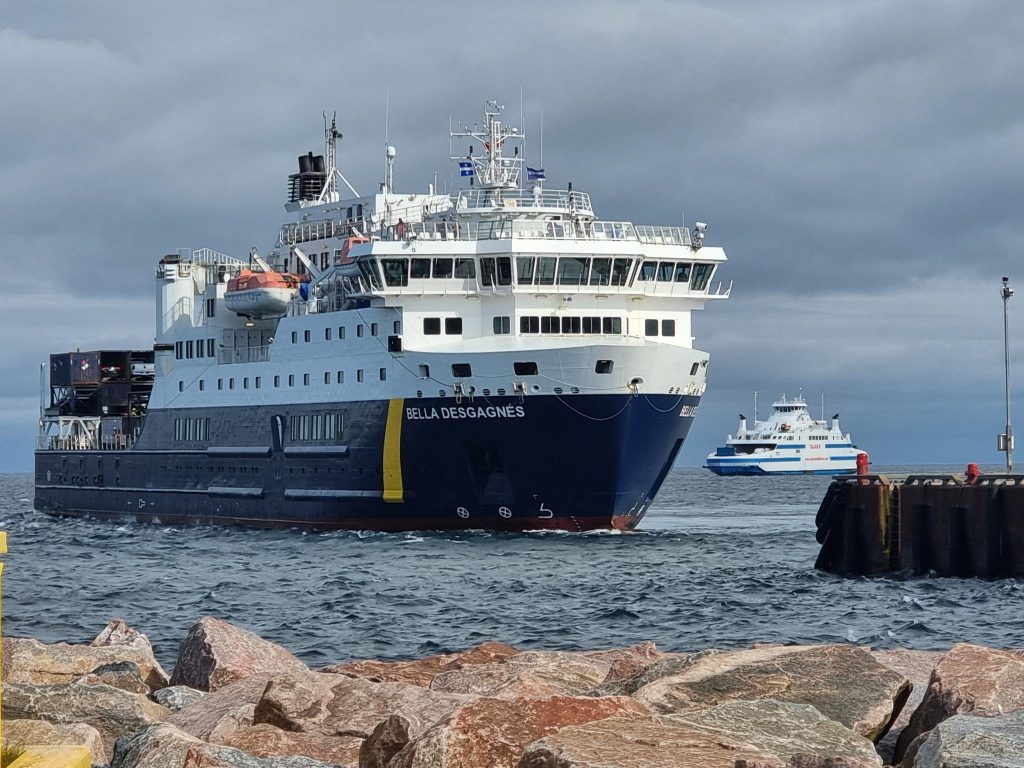
The Bella Desgagnés cargo-passenger ship arrived minutes before the Qajaq W at Blanc Sablon. Its voyage from Rimouski to Blanc Sablon and back to Rimouski takes a week. The first stop is at Sept-Îles on the north shore, then it stops at Anticosti Island, before stopping at other coastal villages. The return trip on Qajaq was considerably delayed according to its schedule. This gave us an opportunity to view the unloading of the Bella Desgagnés. Many unloaded vehicles were making their way to Newfoundland on the Qajaq.
Future Trips
I will probably not visit Labrador again, but Alasdair expressed an interest. The Trans-Labrador Highway (TLH) is the primary public road in Labrador, with a length of 1 149 km. The original western/central portion of the TLH is designated as Route 500 and measures 543 km from the Quebec – Labrador boundary through Labrador City/Wabush, Churchill Falls, and Happy Valley-Goose Bay. From there, heading southeast is Route 510 = Labrador Coastal Drive, 606 km. Centres en route include Cartwright Junction, Port Hope Simpson, Mary’s Harbour, Lodge Bay and Red Bay.
The TLH runs through dense wilderness for most of its length. Route 500 connects with Quebec Route 389, which runs 567 km through wilderness north from the Quebec – Labrador boundary to Baie-Comeau, where it connects with Quebec Route 138. At one time Quebec promised that the route would follow the entire north shore of the St. Lawrence River eastwards to Blanc-Sablon. This has not happened. However, The western terminus is in Elgin, at the border with New York State south-west of Montreal. At the Trout River Border Crossing, it connects with New York State Route 30. Route 30 leads to Schenectady County, where some of my biological relatives settled about 1660.
Back to Happy Valley
If one wants to explore the coastal communities north of Happy Valley – Goose Bay, there is a ferry service that operates each summer in the ice-free season, from roughly June to November. The Kamutik W is often described as a sister ship to the Qajaq, although it is outfitted very differently. It began life as the Hiiumaa in 2011, and sailed in Estonia.
In its new life it has a weekly schedule. It departs Happy Valley-Goose Bay and visits each community on its voyage north. At Nain (most northerly community), it turns around and revisits each community on the return trip to Happy Valley-Goose Bay.
Unloading vehicles from the Belle Desgagnés at Blanc-Sablon. Photo: Alasdair McLellanUnloading vehicles from the Qajaq W at Blanc-Sablon. Photo: Alasdair McLellan.
Wikipedia tells us that demography is the statistical study of human populations: their size, composition and how they change through the interplay of fertility, mortality and migration. In trying to learn more about the population of Newfoundland and Labrador I consulted Statistics Canada data, but allowed Wikipedia editors to summarize some findings to gain further insights. Since entering confederation in 1949, Newfoundland and Labrador have always been the 9th most populated Canadian province.
In terms of provinces, only Prince Edward Island is less populated, at about 177 000. On 2024-04-06, Statistics Canada’s population clock indicated that New Brunswick’s population had grown to 850 000. Nova Scotia has seen record population growth in recent years, with young people moving in from Ontario and other provinces. Nova Scotia is attempting to reach 2 000 000 by 2060, but faces challenges in health care, education and housing.
Newfoundland and Labrador (NL) reached their maximum population in about 1991, at somewhere around 568 500 people. Since then, it has declined, reaching about 510 500 people in 2021, the last census year. More than half live on the Avalon peninsula.
Labrador has an area of 294 330 km2 and a population in the last census (2021) of 26 655.
In terms of NL, one has to ask why its population has stagnated, if not declined? NL has been overly dependent on one resource, fish, and cod in particular. There are some exceptions. In Corner Brook and Grand Falls – Windsor, there is an emphasis on forestry and pulp and paper production.
In the following section, a comparison will be attempted between Trinity and Twillingate. Both are small villages, yet they are very different.
Trinity
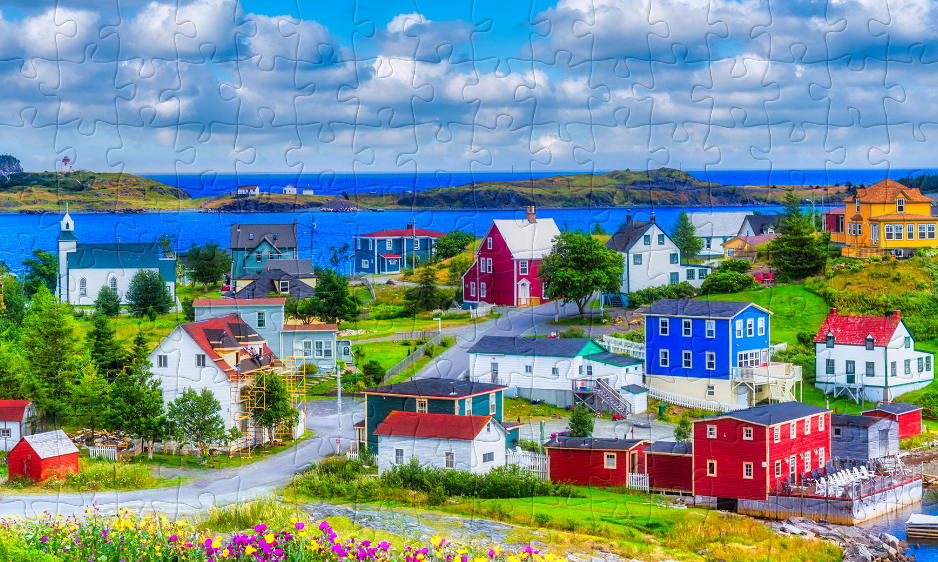
This is not just a photograph of Trinity, Newfoundland. It is also a screenshot of a jigsaw puzzle I created on 2024-07-21, using 1 hour 44 minutes and 53 seconds to complete the puzzle.
If I have one piece of advice to travellers to Newfoundland, it is to avoid visiting the village of Trinity. The problem with Trinity, is that they have done everything right to make it into a model village. It is more Disneyland, than a thriving village.
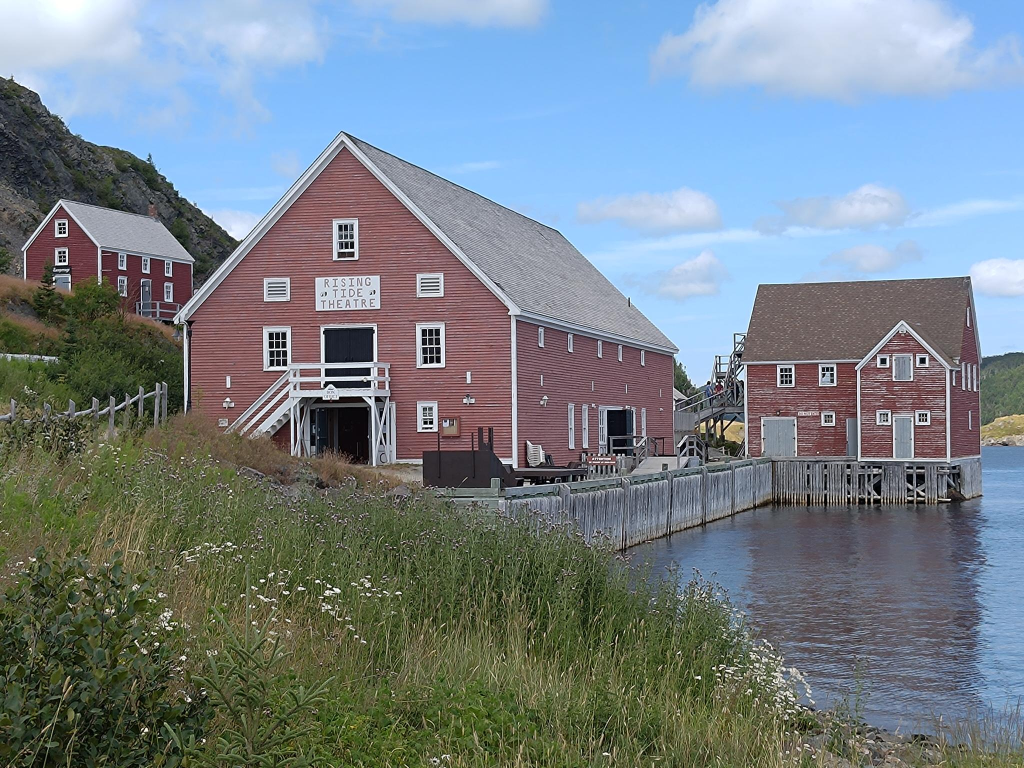
The Rising Tide Theatre is one of many attractions in Trinity.
There are many attractions in the village, including the Rising Tide Theatre. However, there is little coordination, and almost no parking. We were able to park at the museum because it was closed for an hour long lunch in the middle of the day.
Twillingate
About 300 km north-west of Trinity, and about 112 km = 1.5 hours driving, north of Gander, is the town of Twillingate, with a population just over 2 000. It calls itself the Iceburg capital of the world. To arrive there, one travels across several islands connected by causeways, including New World Island, which commemorates the 1523–24 expedition of Giovanni da Verrazzano (1485–1528) to Newfoundland that established the coast to be part of the New World rather than Asia. Yes, that was over 500 years ago! Fogo is the one island in the area still requiring a ferry connection.
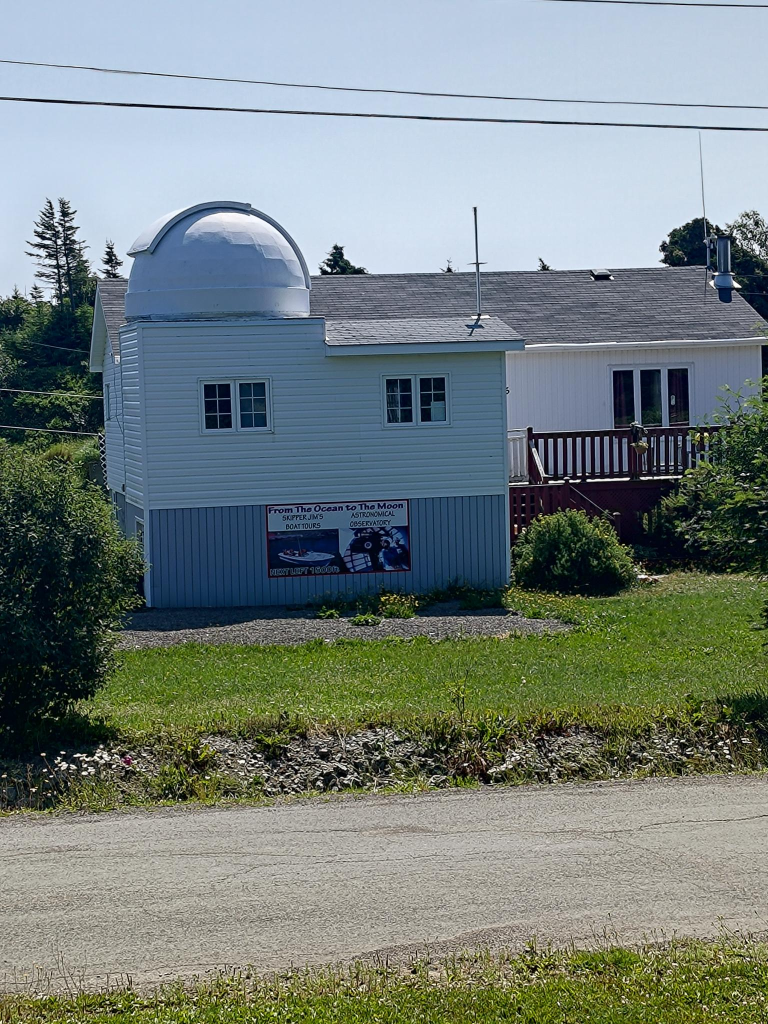
Our stay there was the most refreshing of the trip, we rented a cottage outside of the town. Across the street from our cottage, retired fisherman Jim Gillard has expanded his horizons, setting up a $16 000 telescope in the hand-built Twillingate Astronomical observatory, in his front yard.
Across the street from our cottage, Skipper Jim had opened the Twillingate Astronomical Observatory. It was a way to transform a hobby into a livelihood, and less competitive than turning a fishing boat into a whale watching vessel.
This is not the only attraction. A few hundred meters away, is the Top of Twillingate walk, which provided a refreshing view of the area. This is the one part of Newfoundland that I would want to visit again. We also visited the town, which is divided between two islands, South and North Twillingate. We also visited the Long Point lighthouse, located in the town (?) of Crow Head, also located on North Twillingate. The town’s current population is 156, and declining.
Low Mist Pond with the Top of Twillingate pathway around it.
Travelling to New France from St. John’s, Newfoundland involved a day of travel: one drives on the Trans Canada Highway across the Avalon peninsula to the Burin peninsula, then turns left at Goobies onto Highway 210. One keeps driving on it, until one reaches Marystown. A right turn onto Highway 220, leads to the port of Fortune, which is where the SPM ferries dock in Canada. From there those with vehicles reverse onto the ferry, so they can drive forward when they arrive in Saint-Pierre. Altogether, this involves 363 km and almost 4 hours of driving. The ferry from Fortune to Saint-Pierre is about 45 km, and takes another 1.5 hours.
If one is fortunate in Marystown, one meets the Little Green Devil, a 1965 Rambler American 2-door sedan. This model, and many others in the Rambler lineup, was designed by Dick Teague (1923 – 1991). From my perspective, it is Teague’s most successful design. These vehicles are known for their smooth ride, despite their compact size. WhiIe I would not criticize anyone’s vehicle preferences (with the possible exception of motorcycles), i prefer utility vehicles ( vans and station wagons). Vehicle solidity is my focus. Thus, I prefer vehicle construction incorporating a frame around every door, in contrast to flimsier hardtop models. Despite having a driving license since Tuesday, 1965-01-05, I have owned only four vehicles, including one jointly with my wife, Trish.
At Fortune, we were able to eat a chicken dinner at Mary Brown’s. This was our first experience of this fast food chain. Originally it was named Golden Skillet, the first location was at St. John’s Avalon Mall. However, the owners were forced to rename the establishment for legal reasons. Currently, there are over 300 locations across Canada.
After that meal we picked up our ferry tickets, then went next door to arrange to park our rental car for two days on the outskirts of town. We were driven back to the ferry terminal. The 1.5 hour ferry ride was uneventful. There was little to see apart from waves on the ocean, despite having window seats.
St. Pierre
The Overseas Collectivity of Saint-Pierre and Miquelon = Collectivité d’outre-mer de Saint-Pierre et Miquelon (referred to hereafter as SPM) has a population of about 6 000, and occupies an area of 242 km2 on eight islands. It is located about 19 km west of Point May on the Burin peninsula.
Two almost identical ferries provide for much of the transportation needs of the archipelago. These are the blue hulled Nordet and the red hulled Suroît. The vessels are 56.7 m long, with a 768 UMS tonnage. Both entered service in 2019. They are named after a northerly, and southerly wind, respectively.
Compared to the casual, and often inappropriate dress of deck crew on Norwegian ferries, the deck crew of these French ferries were dressed for any emergency. They were equipped with helmets, hi-vis vests, life preservers, gloves and safety shoes.
After landing in St. Pierre, we passed through French immigration and were able to enter France. We walked through the town, until we found our bed and breakfast, where we had rented two rooms. This was followed by yet more walking around the town. The gradient was intermediate to my two reference points. It was steeper than most places in Inderøy, Norway, but not as steep as the worst hills in New Westminster, British Columbia, Canada.
St. Pierre, the island and village is named for St. Peter, the patron saint of fishers, net makers and ship builders. He was born Simon, possibly Simeon. Both he and his brother Andrew were themselves fishers, later, they became two of the twelve apostles. Details of Peter’s life are vague, although he was the Bishop of Rome = Pope, from 30 AD to his death 64 – 68 AD, crucified by Nero (37 – 68).
While Saint-Pierre is far too urban for my tastes, with a population over 5 000, and an area of 26 km2, Grande Miquelon is appropriately populated (ca. 700 people) and sized (110 km2). If I lived there, I am sure that I would want to spend much of my time in the wilderness of Langlade.
Air Travel
One of the main reasons for wanting to visit SPM was to experience flights with Air Saint-Pierre. We were going to fly both ways on inter-island flights between Saint-Pierre and Miquelon.
On Monday, 2025-07-23, we left our bed and breakfast at 07:30 and walked to Aéroport de Saint-Pierre = Saint-Pierre Airport (FSP), a regional airport located south of Saint-Pierre. It opened in 1999 and consists of four buildings excluding the control tower. It replaces an older airport that opened in 1965. The new 08/26 runway is 1 800 m long, while the old 11/29 runway was 1 250 m, not long enough for most commercial aircraft.
The passenger terminal at 2 200 m2, is large given the traffic.
We boarded our aircraft at about 08:30, without any form of security check. It took about 10 minutes to get the aircraft in condition to fly. After about 15 minutes in the air, we were landing at Aéroport de Miquelon = Miquelon Airport (MQC), the regional airport on Miquelon Island. The 12/30 runway is only 1 000 m long, suitable for the Reims-Cessna F406 Caravan II machine, but nothing much larger.
Our return flight was delayed, because the number of passengers exceeded the number of seats available. Thus, we had to wait until the plane flew to Saint-Pierre, then returned to pick us up. Alasdair was happy that he was issued seat 1A for both flights. I was assigned 1B for both flights.
Flying close to the village of Miquelon, on a landing approach. Photo: Alasdair McLellan.
Here I am emerging as the last passenger out of our aircraft, a Reims-Cessna F406 Caravan II of unknown vintage. Photo: Alasdair McLellan.
The Suroît off Miquelon.
I have experience with ferries, of various types, especially from six years with weekly commutes in Norway between Molde and Inderøy, usually involving four ferries each week. I appreciate their efficiency, especially in docking, unloading and loading vehicles. However, I note the lack of crew safety equipment.
Here, the deck crew of Suroît are dressed for any emergency. They are equipped with helmets, hi-vis vests, life preservers, gloves and safety shoes. Later, I talked with Fréderique Ragot, about her work.
Visiting remote airports and train stations is one of the perks of being the parent of someone who studied transportation economics, then took a B.Com. with a marketing specialization, before turning to history, ending with a M.A. and a thesis about the development of a now-defunct Norwegian airline.
Regional Influences
While the official flag of SPM is the French flag, an unofficial SMP flag is also used. Because of my interest in flags, often collecting them from places I visit, I wanted to buy a SPM flag. This proved impossible. Much of the flag contains elements found on the SPM coat of arms. Along the hoist, from bottom to top, are the flags of Normandy, Brittany and, in the uppermost position, the Basque Ikurriña, officially described as a white cross over a green saltire on a red field. Basque nationalists Luis Arano (1862 – 1951) and his brother Sabino (1865 – 1903) developed the Basque flag. Its neologistic name comes from ikur ‘mark, sign’ (itself a neologism extracted from irakurri ‘to read’). These are the places that contributed most of the population of SMP.
The yellow ship on the flag represents the Grande Hermine, the carrack which brought Jacques Cartier (1491 – 1557) to Saint Pierre on 1535-06-15.
World War II
Yet, another reason for this trip to this part of the world, was to understand the situation my parents encountered when they were stationed with the Royal Canadian Air Force, in Newfoundland, for a large part of World War II. Newfoundland was not yet part of Canada, but British territory. SPM was (and still is) part of France. Decisions often involved four countries, with a theoretically neutral USA wanting to make decisions.
The Third French Republic had begun World War II in 1939-09-03 on the side of the Allies. On 1940-05-10 it was invaded by Nazi Germany. Paul Reynaud (1878 – 1966) resigned as prime minister and was replaced by Philippe Pétain (1856 – 1951). On 1940-06-22, Pétain signed an Armistice that created Vichy France that, on paper, existed from 1940-07-10 to 1944-08-09. Vichy was the seat of government, about 400 km south of Paris.
The Vichy government was authoritarian, antisemitic and, somewhat later, anti-Soviet. Yet, it never joined the Axis powers and was formally at war with Germany. In practice, it was collaborationist. SPM authorities had sworn their allegiance to the Vichy French government.
There were concerns in Newfoundland (NL), Britain and Canada, that the Axis powers might use SPM as a base of operations, offering German submariners an excellent position to re-supply and coordinate attacks upon Allied convoys. Wireless communication and transatlantic cables allowed the islands’ authorities the opportunity to transmit vital information to Vichy France and onwards to German submarine crews about weather conditions, the movements of Allied warships and convoys. There was also concern that local fishery products could be sent to Germany through mainland France.
NL wanted a pre-emptive invasion of SPM. Canada was against this for fear of offending USA. As the Battle of the Atlantic reached Canadian waters in 1941, The Canada–United States Permanent Joint Board on Defence had unanimously agreed that the existence of an uncontrolled and high-powered wireless transmitting station on SPM constituted a threat to the interests of Canada and USA. Yet, USA opposed the use of force to take control of SPM.
Charles de Gaulle (1890 – 1970), Chairman of the (Free) French National Committee 1940-06-18 to 1944-06-03 asked Admiral Émile Muselier (1882 – 1965) to investigate the possibility of invading the islands, then ordered their capture.
On 1941-12-23, a French flotilla, the submarine Surcouf and three corvettes, Mimosa, Aconit and Alysse, sailed from Halifax under the pretense of a training mission. It arrived off Saint-Pierre and disembarked 230 armed sailors. They met no resistance and captured the island in only 20 minutes. Some sources state that Miquelon was captured the same day, others the following day. The Free French authorities organized a plebiscite on 1941-12-25, but only males over 18 years were given a choice of “rallying to Free France or collaborating with Axis powers”. Almost 98 per cent voted in favour of Free French administration.
I find it noteworthy that the French named their largest submarine after a slave trader and privateer, Robert Surcouf (1773 – 1827).
The US Secretary of State, Cordell Hull (1891 – 1955), called the capture of SPM a violation of the Monroe Doctrine. He wanted to prohibit French citizens exercising their democratic rights. He wanted SPM to restore its Vichy government. The Monroe Doctrine, first articulated 1823-12-02, is a United States foreign policy position that opposes European colonialism in the Western Hemisphere. Any intervention in the political affairs of the Americas by foreign powers is a potential hostile act against the USA.
Despite Hull’s protests, this incident was soon forgotten. The Japanese attack on Pearl Harbor, 1941-12-07, and the declaration of war on the USA, by both Japan and Germany, meant that Vichy France had become an enemy.
In the 1930s, many Americans were isolationists, not wanting to involve themselves in wars. Others were sympathetic to the Nazi cause. The situation has not dramatically changed in recent years, with Donald Trump wanting the USA to imitate its past, and for it somehow to become great, again. It is instructive to look at the demographics of the Capitol insurrectionists in Washington D.C. on 2020-01-06. They were predominantly white, male, aged 30+, trained and working as professionals. They were not the downtrodden.
Greatness is not measured by the number of billionaires. I am a limitarian, a believer in putting strict limits on personal wealth, with a maximum vastly below a billion $/ €/ £. One percent of that amount should be sufficient for everyone.
Mountains
Many mountains in the Canadian Rocky mountains were named for French generals prominent in World War I in 1919. Mount Pétain was one of these, located on the border of the Canadian provinces of Alberta and British Columbia on the Continental Divide. Geoffrey Taylor (1952 – 2020), a former University of Calgary professor of infectious diseases, campaigned from 2016 to his death, to remove the name of the Nazi collaborator from the mountain. In 2019, Alberta rescinded Pétain’s name from the Alberta side of the border. In 2022, British Columbia also rescinded the name, leaving the mountain and other features previously associated with Pétain, nameless.
Time
Clocks are an important technology for the world. I appreciate Sandford Fleming’s (1827 – 1915) promotion of 24 worldwide standard time zones, a prime meridian, and use of the 24-hour clock. He saw these as necessary elements for communicating time accurately. I am also glad that there is an International Telecommunications Union (ITU), that has created a world time standard, Coordinated Universal Time (UTC). A weblog post on the ITU is scheduled for its 160th anniversary, 2025-05-17. Here many other aspects of time will be discussed.
In this post, I would like to restrict myself to expressing a minor, but unnecessary, irritation with Newfoundland. At the same time, I would like to thank SPM for not following in its wayward footsteps. This irritation can be expressed as Newfoundland and Labrador, having a time that offsets those of a time zone, by 30 minutes.
This post is being published on Ukrainian independence day = День Неза лежності України, 2024-08-24, in commemoration of the Declaration of Independence in 1991.